Salt air is the quiet operating cost every coastal homeowner eventually understands. It does not announce itself. It does not appear in a home inspection report as a single line item. It just steadily accelerates the aging of every material on the house, and the bill for that acceleration shows up over years and decades rather than in a single event. Buyers who understand what salt actually does to homes plan for it in their maintenance budget. Buyers who do not are surprised in year three when the HVAC condenser fails and the paint on the south side of the house has already flaked.
Here is the honest picture of what salt air does to coastal North Carolina homes, drawing on years of walking properties from Wrightsville Beach and Carolina Beach down through Oak Island and the Brunswick beaches.
How Salt Actually Attacks a House
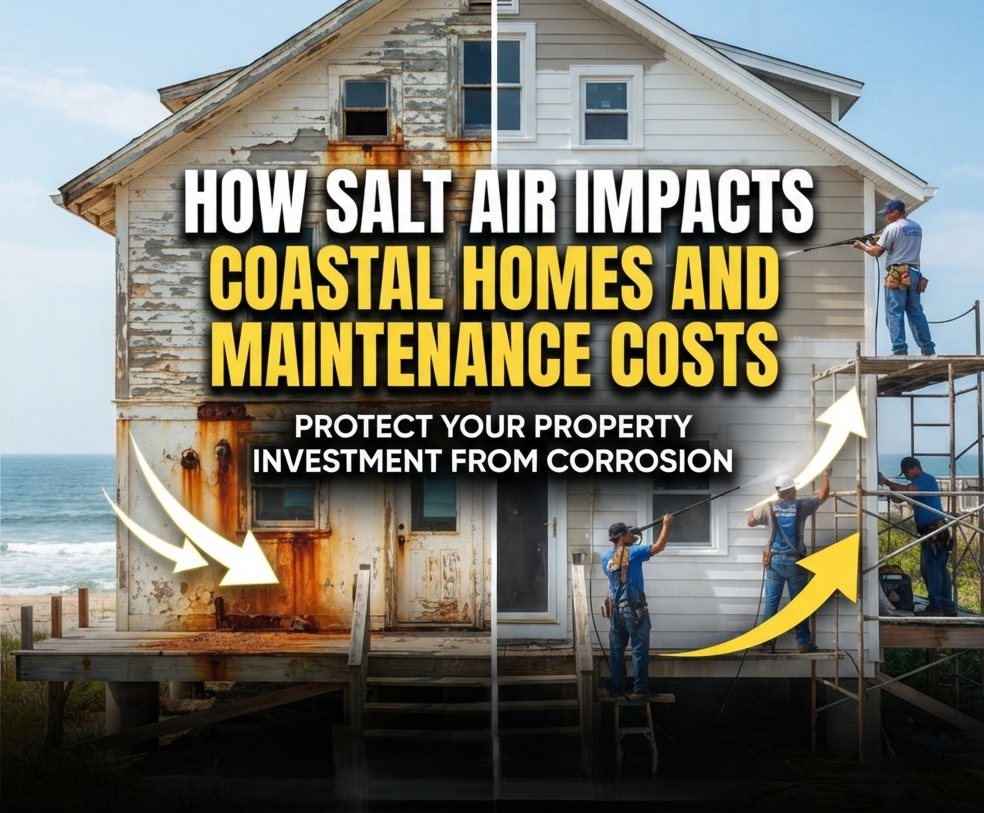
Salt aerosols are carried inland by wind. They deposit on every exterior surface — roof, siding, decks, windows, HVAC condensers, exterior lights, hardware, and door thresholds. When those surfaces are also exposed to sun and moisture, the salt accelerates oxidation, corrosion, and material breakdown. Metal corrodes faster. Paint fails sooner. Rubber and plastic degrade more quickly. Wood decays sooner in humid, salt-laden conditions.
The intensity of exposure drops with distance from open water. An oceanfront home experiences a fundamentally different maintenance cycle than a home a mile inland. Homes on Oak Island, Wrightsville Beach, and Bald Head Island are the most exposed. Homes in inland Leland, Hampstead, or western Wilmington see much lower salt loads. Both still qualify as coastal, but their maintenance profiles are meaningfully different.
What Wears Out Fastest
HVAC Condensers
The single most-common salt-driven failure is the outdoor HVAC condenser. Salt corrodes the aluminum fins, seizes the fan motor bearings, and eats away at the copper coil connections. Coastal condensers typically last 10 to 12 years instead of the 15 to 20 that inland units achieve. Coastal-rated condensers with protective coatings can extend the life meaningfully, but they cost more up front.
Roofs and Flashing
Salt accelerates the wear on shingle asphalt, causing granule loss and shortening functional roof life. Roof flashing, drip edges, chimney caps, and roof vents corrode. Coastal roofs typically need replacement at 15 to 20 years instead of the 25 to 30 that inland roofs commonly achieve.
Exterior Paint and Stain
Paint on the sunny, wind-exposed sides of the house — usually the south and east on this coast — fails faster than on protected sides. Coastal homes typically need repainting every 5 to 8 years instead of the 10 to 12 that inland houses often achieve. Deck stain follows the same pattern.
Windows, Doors, and Hardware
Salt corrodes hinges, door locks, window screens, exterior lights, and hardware. Vinyl and aluminum window frames hold up better than wood and steel. Stainless steel and coastal-rated hardware are worth the premium.
Outdoor Furniture and Grills
Furniture, grills, umbrellas, cushions, and outdoor cooking equipment age quickly in salt environments. Investing in quality coastal-rated pieces from the start typically outperforms cheaper replacements over a five-year window.
Vehicles and Bicycles
Not the house directly, but worth mentioning — cars, bicycles, and outdoor toys corrode faster in salt environments. Rinse-off routines make a real difference.
Regional Variation Within Coastal NC
Not all coastal NC homes face the same salt load. Direct oceanfront and immediately near-oceanfront properties experience the highest exposure. Sound side, marsh-front, and ICW-adjacent homes face moderate exposure — usually less than oceanfront but more than inland. Homes a mile or more inland from open water see meaningfully lower exposure. Homes 10 to 15 miles inland behave much like inland markets.
This variation matters when buyers compare carrying costs across properties. Two homes that look similar on paper can have quite different maintenance profiles based on wind direction and distance from the water.
How to Slow the Damage
Rinse Routinely
The simplest and most effective salt-mitigation strategy is regular fresh-water rinsing. HVAC condensers benefit from a monthly rinse. Outdoor light fixtures, door hardware, and exterior surfaces benefit from a quarterly rinse or pressure wash. This routine is not glamorous, but it extends equipment life meaningfully.
Use Coastal-Rated Materials
When it is time to replace anything on the exterior — condenser, hardware, lights, deck screws, roof flashing — spend the extra for coastal-rated or marine-grade materials. The initial cost premium typically pays back within a few replacement cycles.
Invest in the South and East Sides
The south- and east-facing sides of the house take the most sun and wind exposure. Higher-quality paint, thicker sealants, and more frequent maintenance on those sides return more than the same investment on the protected sides.
Do Not Delay Maintenance
Deferred maintenance compounds on the coast. A roof issue that could be a $500 flashing repair in year one becomes a $6,000 water-damage repair by year three. Coastal homes penalize procrastination.
Budgeting the Real Costs
A reasonable annual maintenance budget for a coastal NC home runs 1 to 3 percent of the home's value, with the higher end applying to oceanfront and near-oceanfront properties. On a $1,000,000 home, that means $10,000 to $30,000 annually as a rolling average. Some years are lower — a quiet year with just routine maintenance. Some years are much higher — a roof replacement or HVAC replacement year. The average matters more than any single year.
Owners who set up a dedicated coastal reserves account and contribute monthly generally handle these costs without stress. Owners who wait for the bill to arrive often scramble.
What Buyers Should Ask Before They Contract
Age of the roof, age of the HVAC systems, most recent exterior paint or stain year, condition of decks and porches, and the seller's routine maintenance history. All of these should be part of the diligence conversation. Homes that have been maintained proactively are worth measurably more than homes that have been let go, even when the two look similar in photos.
Key Takeaways
Salt air is a real and steady operating cost of coastal North Carolina ownership. It accelerates the aging of every exterior material on the home — HVAC condensers, roofs, paint, hardware, windows, doors, and decks — and it does so quietly enough that buyers who did not plan for it are often surprised by year three or four. The right response is not to avoid the coast; it is to buy the home with realistic maintenance expectations, budget 1 to 3 percent of value annually for upkeep, invest in coastal-rated materials during any replacement cycle, rinse and pressure-wash routinely, and address issues before they compound. Homes that have been maintained proactively are worth measurably more at resale than homes that have not. Buyers who go in understanding the salt-air math consistently love their coastal home. Buyers who assume coastal maintenance costs match inland maintenance often become the sellers who wonder why their home is not showing well after five years. Coastal ownership rewards attention to the exterior. Everything else follows from that.