After three decades of watching buyers navigate coastal North Carolina, the same mistakes keep repeating. The specific submarket changes, the specific home changes, the specific buyer changes — but the underlying missteps stay the same. Each one is preventable, and most of them are cheap to avoid. Buyers who go into this market knowing the common traps consistently avoid them. Buyers who do not tend to learn the lessons the expensive way in year two or three.
Here is the honest list of the biggest mistakes buyers make when purchasing a coastal NC home, drawing on years of walking properties across Wilmington, Leland, and the beach towns like Oak Island, Carolina Beach, and Wrightsville Beach.
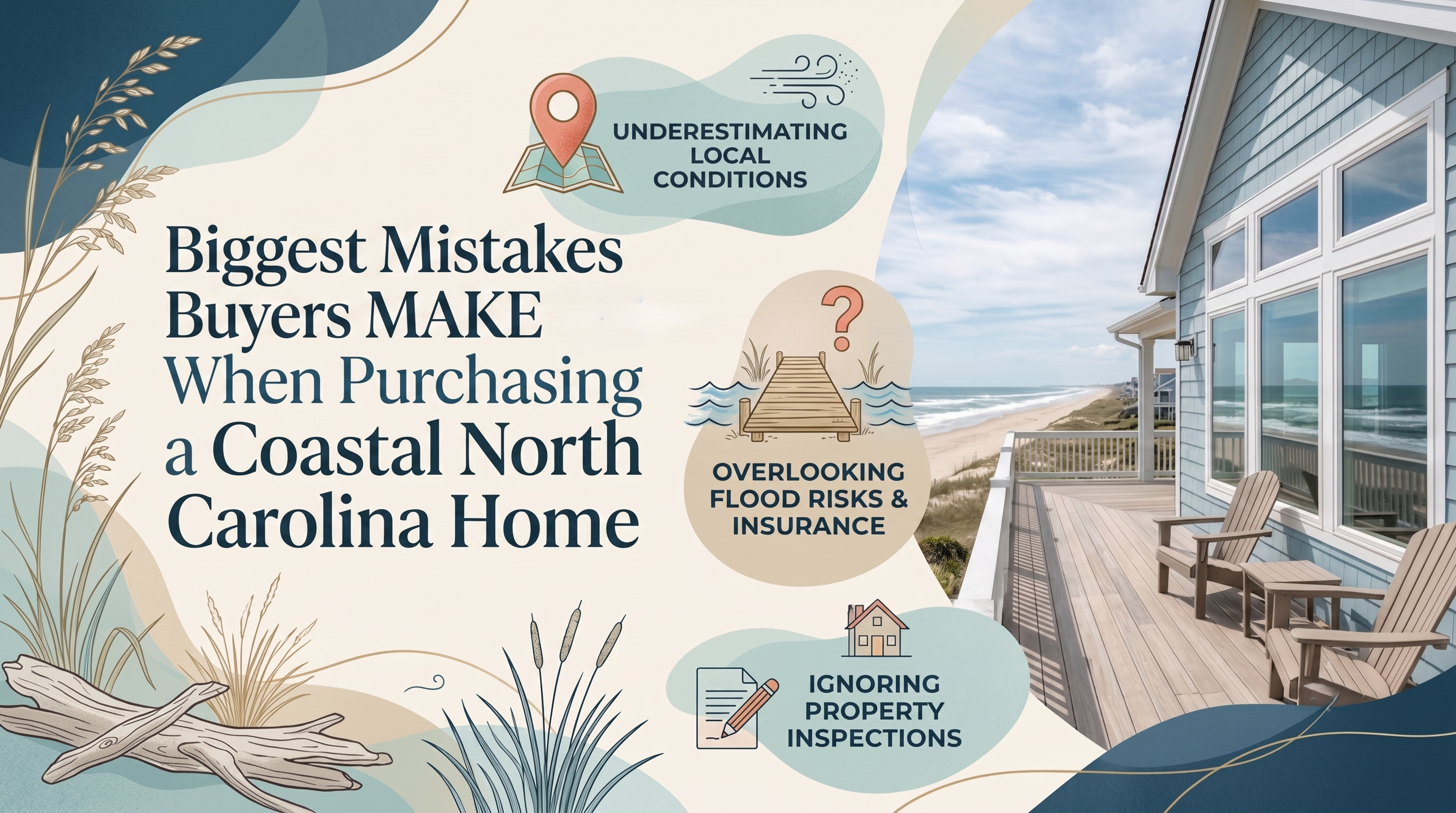
Skipping the Insurance Quote Until It Is Too Late
The single most common mistake is treating insurance as a final-week formality. On the coast, insurance is a defining part of the carrying cost. Wind and hail, flood, and homeowners premiums together can add hundreds to over a thousand dollars a month to what a buyer thought the house would cost. Buyers who quote insurance during due diligence make sharper decisions. Buyers who wait until loan underwriting sometimes discover the true cost when it is too late to walk away without losing the deposit.
Falling in Love With the Home Before Understanding the Community
A beautiful home in the wrong community produces quiet frustration that shows up over years. Buyers who spend the search process focused on interior finishes, kitchen layouts, and the master closet often skip the harder question of whether the community fits their actual life. The wrong community cannot be renovated. The wrong home can be.
Ignoring the HOA Documents
Coastal NC has some of the most detailed HOA structures in the Southeast, and buyers routinely sign contracts without reading the covenants, budget, reserve study, or meeting minutes. Then they discover in year one that their fence type is not allowed, or the dues are about to go up 20 percent, or a special assessment for roof replacement is on the way. The documents contain the answers. Buyers who read them close deals with clarity.
Underestimating Salt-Air Maintenance
Buyers relocating from inland markets often underestimate how fast coastal environments age homes. HVAC condensers, roofs, paint, hardware, and outdoor materials all wear faster here than they did in the buyer's previous state. Budgeting inland maintenance rates on a coastal home consistently produces surprise expenses. Coastal maintenance is real, predictable, and 1 to 3 percent of home value annually as a rolling average.
Skipping the Flood Determination
Many buyers rely on a listing description that says "Zone X" or "no flood insurance required" without pulling the current FEMA determination. Flood maps change. Descriptions get out of date. Buyers should pull the flood determination themselves during diligence and confirm the current zone, base flood elevation if applicable, and prior claims. This is inexpensive, quick, and prevents one of the most common post-closing surprises.
Waiving Inspections in a Softer Market
The urge to waive inspection came from the 2020 to 2022 market. In 2026, the market has cooled enough that buyers rarely need to waive to compete, yet some still do. Coastal homes hide moisture and salt issues that inspections uncover. Skipping the inspection to save a day or a thousand dollars is one of the fastest ways to inherit a five-figure repair problem.
Not Verifying Internet Speeds
Remote workers and hybrid professionals often assume high-speed internet is universal in the region. It is not. Fiber and gigabit cable service is broadly available in most established markets, but specific streets, condos, and rural pockets can lack it. Verify at the specific address, not the general neighborhood.
Underestimating Storm Prep Requirements
Every hurricane season, buyers who closed the previous winter discover they do not have shutters, a plan, or storm supplies. First-year owners routinely spend 20 to 40 percent more on storm prep than experienced coastal owners because they are buying everything at once and often at retail. Storm prep is not a crisis expense; it is a routine ownership expense that should be part of year-one budgeting.
Buying Too Much House
The excitement of a new coastal home leads buyers to stretch on square footage, amenities, or view. On the coast, every extra square foot costs to insure, cool, maintain, and repair. Buyers who buy the right amount of house for their actual usage consistently love ownership. Buyers who stretch often quietly resent the carrying cost by year two.
Overlooking Property Tax Overlays
Buyers compare county tax rates without realizing that municipal overlays inside beach towns and inside city limits add meaningfully to the bill. The same $600,000 home can have very different annual property tax bills depending on whether it is inside town limits or a mile down the road in unincorporated county. This is easy to check and worth checking.
Skipping the CLUE Report
The CLUE (Comprehensive Loss Underwriting Exchange) report shows a home's insurance claims history. Prior wind, flood, water, or liability claims affect what future premiums will look like. Buyers should request the CLUE report during due diligence rather than discovering an unexpected claims history from the insurance carrier at underwriting.
Trusting Marketing Language Over Verification
"Oceanview," "steps to the beach," "deepwater dock," "just minutes to Wilmington" — all of these are marketing phrases that mean different things to different sellers. Verify. Walk the walk. Test the drive at rush hour. Measure the water depth. Look at the view from the room the buyer would actually use. The verification is inexpensive; the assumption is expensive.
Not Working With an Agent Who Knows Coastal Specifically
Coastal NC transactions have layers that inland transactions do not — flood, wind, salt, HOA reserves, dock rights, CAMA permitting, evacuation zones, and vacation-rental regulation. An agent who works this market every week reads the risks and opportunities in seconds. An agent who mostly works inland transactions can miss issues that would have saved the buyer thousands.
Failing to Plan for Resale
Buyers who plan a five-year hold and then decide after two years to sell often discover that the specific submarket, price point, or property type has limited buyer appeal. Choosing a home with broad buyer appeal at resale is a form of insurance. Niche properties can be right for the right owner but are also harder to sell when circumstances change.
Key Takeaways
- Quote insurance during due diligence, not at underwriting — coastal premiums can define carrying cost and change deals
- Prioritize community fit as much as home fit — the community cannot be renovated
- Read the HOA covenants, budget, reserve study, and meeting minutes before contract
- Budget for coastal salt-air maintenance at 1 to 3 percent of home value annually
- Pull the current FEMA flood determination and get an elevation certificate on AE and VE properties
- Never waive inspections — coastal moisture and salt issues hide from anything less than a licensed inspection
- Verify internet speeds at the specific address for remote workers
- Plan storm prep as a routine year-one expense, not a hurricane-week scramble
- Do not overbuy — every extra square foot carries coastal operating cost
- Verify municipal tax overlays; run the actual annual bill on the specific home
- Request the CLUE report during diligence
- Verify marketing language with your own eyes, feet, and measurements
- Work with an agent whose day-to-day is coastal NC transactions
- Choose a home with broad resale appeal unless committed to a long hold
Frequently Asked Questions
How can I tell if a home is a good fit for the community I want?
Spend a weekend living the intended lifestyle in that community before contract. Coffee, groceries, restaurants, rush-hour drive, the local park, the local farmers' market. Two days of real presence reveals more than any number of showings.
Should I always request an elevation certificate?
Yes if the home is in an AE or VE flood zone. Optional but useful in Zone X properties when planning renovations. The document simplifies future insurance renewals and buyer negotiations at resale.
What is a fair coastal home inspection budget?
Plan for $500 to $1,200 for the general home inspection, $150 to $400 for a wood-destroying-organisms inspection, $300 to $800 for a septic inspection if applicable, $150 to $400 for a well test if applicable, and $400 to $800 for an elevation certificate if needed. Total often $1,500 to $3,500 for a comprehensive coastal diligence package.
How do I evaluate an HOA before contract?
Request the covenants, current budget, reserve study, prior three years of financial statements, and past twelve months of board meeting minutes. Read them all. Any HOA that resists producing these documents is telling you something.
Is it worth quoting insurance from multiple agents?
Yes. Rates for the same coverage vary meaningfully across coastal NC carriers. An independent agent who writes multiple markets typically produces better outcomes than a captive agent with a single carrier.