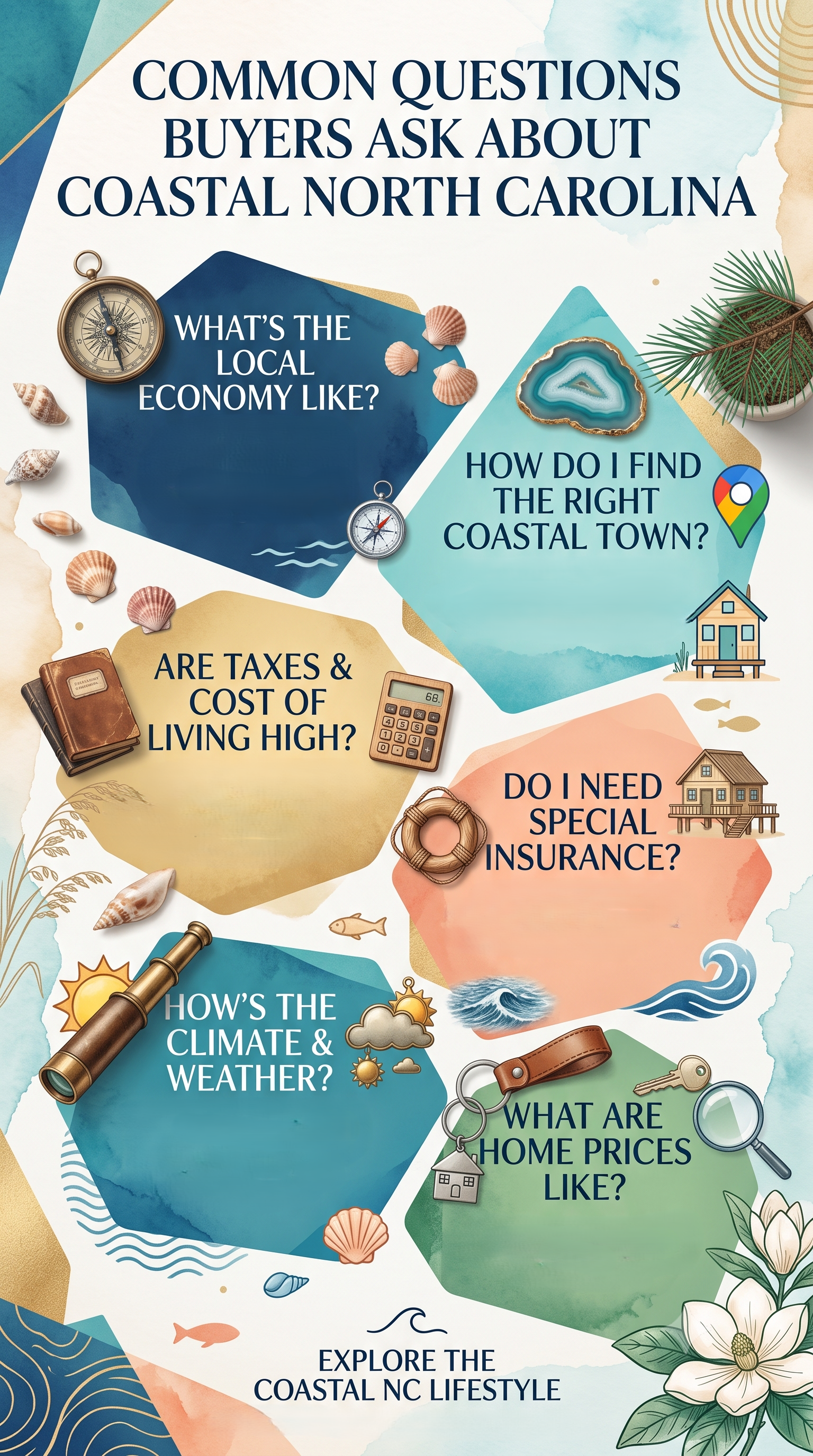
After thirty years of helping buyers land in coastal North Carolina, the same questions come up in almost every conversation. Some are practical (insurance, taxes, hurricane risk). Some are lifestyle (schools, boating, walkability, retirement). And some are the questions buyers were too embarrassed to ask their first agent — the basic ones that everyone should be asking. Here is an honest, plain-English answer to the questions I hear most, drawn from years of conversations across Wilmington, Leland, and the beach towns.
Cost and Affordability Questions
Is coastal North Carolina still affordable?
Compared to coastal Florida, coastal California, and the Northeast — yes, meaningfully so. Compared to inland North Carolina or the Midwest — no, coastal pricing is higher. The honest framing is that this market is affordable for what it delivers, not affordable relative to interior states.
What does a typical home cost in the region?
Median sale prices vary widely by submarket. Wilmington median is in the mid-$400,000s. Leland median is slightly lower, with new construction and amenity communities pushing higher. Beach towns run higher for waterfront and beachfront inventory. Bald Head Island, Wrightsville Beach, and Figure Eight anchor the top end.
Are property taxes reasonable?
Yes. North Carolina property tax rates are moderate relative to national averages, and Brunswick County in particular offers meaningful savings versus New Hanover County (Wilmington) inside city limits. Always run the actual annual bill on a specific home.
Insurance Questions
How expensive is coastal insurance?
Higher than inland but manageable. Typical coastal homes carry three separate policies — homeowners, wind and hail, and flood — with combined annual premiums often in the $3,000 to $12,000 range depending on location, home age, and coverage. Oceanfront homes run higher; inland coastal homes run lower.
Is flood insurance required?
Required for any federally financed home in a Special Flood Hazard Area (Zone AE, VE, or similar). Not required in Zone X, but often carried anyway because premiums are affordable and losses in "low-risk" zones do happen.
Are carriers actually writing coastal NC?
Yes. Private markets have tightened since 2020 but are still active. The state Beach Plan serves as backup. An independent agent who writes coastal wind business is the most useful resource for finding competitive quotes.
Weather and Hurricane Questions
How often do hurricanes actually hit the coast?
Named systems affect the coastal NC region every year or two on average. Damaging direct hits occur less frequently. Most seasons pass with minor impact, though owners should plan as if a serious storm is possible any year.
Are homes really designed to withstand storms?
New construction to current codes is significantly hardened — impact-rated windows, hurricane straps, and roof-to-wall connections are standard. Older homes vary in their hardening; many have been retrofitted over time, but some have not.
How does the coast look after a bad storm?
The community rebuilds quickly. Emergency response, insurance claims processing, and reconstruction have improved every decade. The coast has been through many storms and continues to function well.
Lifestyle and Community Questions
What is there to do year-round?
Beach access, boating, fishing, golf, tennis, pickleball, restaurants, downtown Wilmington cultural events, festivals, farmers' markets, and the outdoor recreation calendar all keep residents busy year-round. Winter is quieter but still active.
How walkable is the region?
Wilmington's historic district, Southport, parts of Wrightsville Beach, Carolina Beach, and select master-planned communities are meaningfully walkable. Much of the region is car-oriented like most of the Southeast.
Are the beaches nice?
Yes. Wrightsville Beach, Carolina Beach, Kure Beach, Oak Island, Holden Beach, Ocean Isle Beach, Sunset Beach, and the Topsail beaches each offer clean sand, family-friendly access, and warm summer water. Each has its own personality.
What about culture and dining?
Wilmington has the deepest cultural infrastructure — theaters, music venues, restaurants, museums, and the film industry. Smaller towns have their own scenes at more intimate scale.
Practical Move Questions
Is the airport useful?
Wilmington International (ILM) connects to several major East Coast hubs. Raleigh-Durham (RDU) is a two-hour drive and offers broader domestic and international options. Both work for most travel needs.
What are the schools like?
New Hanover, Brunswick, Pender, and Onslow counties each run their own school districts. Each has strong schools and weaker schools. Specific assignments matter more than county reputation. Charter and private options are available in several markets.
Is healthcare accessible?
Yes. Novant Health New Hanover Regional in Wilmington is a level II trauma center. Brunswick Novant, Pender Memorial, and specialty practices across the region provide broad coverage. Duke Health and UNC Health referrals are within driving distance.
Is high-speed internet available?
Yes in most established markets. Fiber and gigabit cable service is broadly available in Wilmington, Leland, Hampstead, and most master-planned communities. Rural and some beach town areas can be more variable — verify at the specific address.
Investment and Rental Questions
Do vacation rentals still work as investments?
Yes in the right markets — Oak Island, Holden Beach, Sunset Beach, Carolina Beach, the Topsail corridor. Yields are tighter than 2021 highs but the model still works with the right property and operator.
Is now a good time to buy?
Yes for buyers who are ready. Inventory has loosened, negotiating room is real, and pricing is stable rather than running away. Trying to time the market perfectly usually costs buyers a home they wanted.
What happens with the market next year?
Base case is continued modest appreciation (2 to 5 percent), gradually rising inventory, range-bound rates, and continued in-migration. Insurance is the biggest single variable to watch. Sharp shifts in either direction are less likely than more of the same.
Getting Started Questions
Should I rent before I buy?
For buyers relocating from far away, yes when possible. Even a 30 to 90 day rental lets a buyer test the actual daily lifestyle. Buyers already familiar with the region can typically skip the rental step.
How long should the search take?
Serious searches typically run three to six months from initial visits to closing, though the right home can come up any week. Buyers who are ready to move on the right property when it appears consistently outperform those who are still waiting for the calendar to align.
What is the single most important thing to get right?
Community fit. The right community with the wrong home is a fixable problem. The right home in the wrong community is not. Choose the town, then the neighborhood, then the home, in that order.
Key Takeaways
- Coastal NC is affordable compared to other US coasts and premium compared to inland markets — pick your comparison honestly
- Insurance is real but manageable; work with an independent agent who writes coastal business
- Hurricanes are a genuine consideration but modern building codes and routine preparation make ownership predictable
- The region delivers real year-round lifestyle — beaches, boating, golf, culture, restaurants, and community events
- Schools, healthcare, airport access, and internet all rate as functional or better across most established markets
- Vacation rentals still work in the right submarkets with the right operator
- Community fit matters more than any individual home feature — pick the town first
- The typical serious search runs three to six months; the right home can appear any week
Frequently Asked Questions
How does coastal NC compare to coastal Florida for retirees?
Similar climate, meaningfully lower cost of living, lower insurance in most cases, less crowded, and shorter drives to family in the Northeast. Florida offers slightly warmer January and February and a bigger sports and theme park scene. Most retirees who compare the two side by side land in coastal NC.
Are there gated communities in the region?
Yes. Landfall, Compass Pointe, St. James Plantation, Porters Neck, and several others offer gated access. Non-gated master-planned communities are equally common. Both styles have devoted buyer bases.
How is traffic in Wilmington?
Manageable outside of rush hour, congested on the main corridors at 5 p.m. Cross-city travel that took 15 minutes ten years ago now runs 25 to 30. Growth has caught up with the road network, and state investment is planned but slow to arrive.
What is the closest major city?
Raleigh is about two hours by car. Charleston, SC is about three and a half hours. Both are common weekend or day-trip destinations for coastal NC residents.
Do I need an agent to buy in this market?
A local buyer's agent adds real value — market knowledge, negotiation leverage, coastal-specific diligence, and access to inventory. Buyers who work with the right agent consistently make better decisions than those who try to navigate the market alone.