The phrase “on the water” gets used loosely across the coastal North Carolina market, and it can mean very different things depending on the listing. For buyers shopping in Wilmington, NC and the surrounding coastal towns, the difference between a waterfront home and a water-access home can mean tens of thousands of dollars in price, a different insurance picture, and a very different daily lifestyle. Understanding the distinction up front helps avoid confusion later in the process.
Why This Distinction Matters in Coastal North Carolina
The coastal Carolina region — from Wilmington and Wrightsville Beach down through Carolina Beach, Oak Island, Holden Beach, and the Brunswick County islands — has more “waterfront” labels than most buyers realize. There are tidal creeks, marsh frontage, sound frontage, intracoastal frontage, canal frontage, oceanfront, and dozens of community waterfront amenities. Each affects the value of a home for different reasons, and a generic search for “waterfront” can return everything from a true ocean-view property to a cul-de-sac home with a community kayak launch a quarter mile away.
Buyers relocating to coastal NC from inland markets often assume waterfront carries one definition. It does not. That is why the difference between owning the waterfront and simply having access to the water deserves a closer look.
What "Waterfront" Really Means
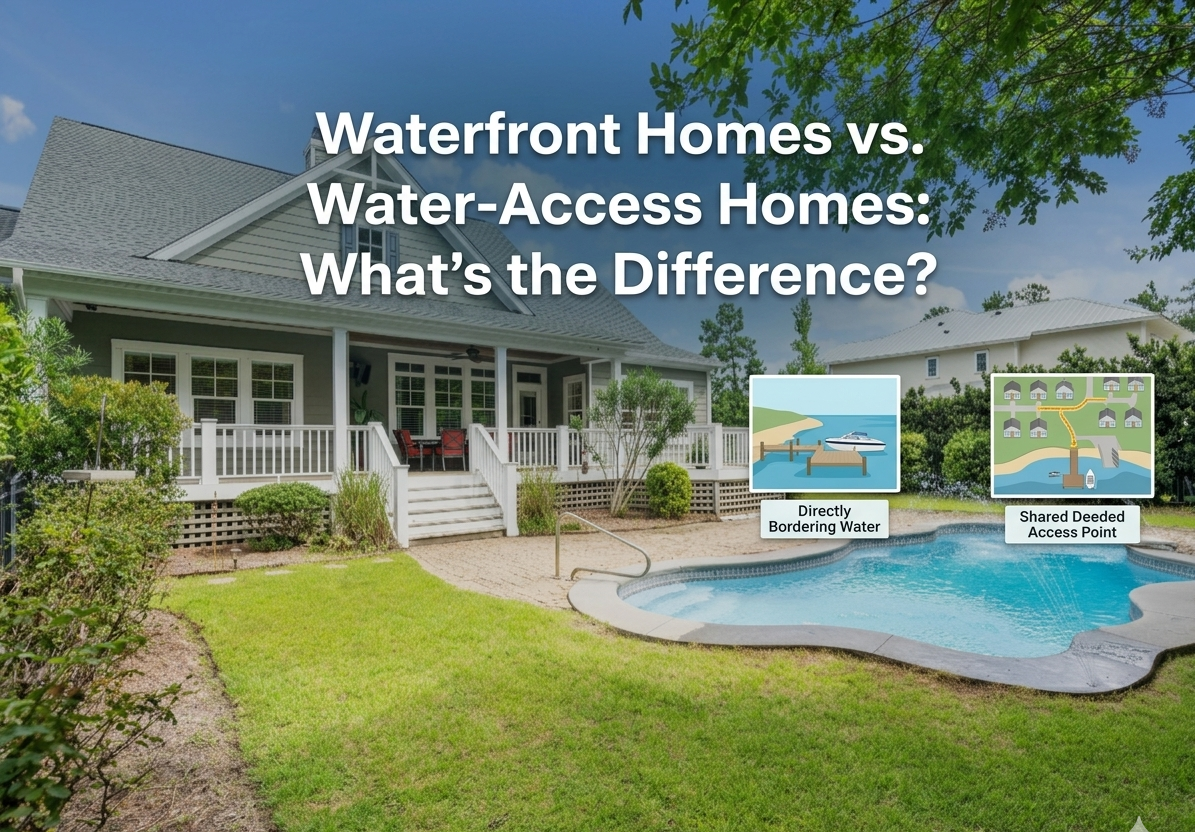
A waterfront home is one whose lot directly touches a body of water — the lot line extends to the shoreline, bulkhead, or mean high-water mark. In the Wilmington real estate market, the most common types of true waterfront include:
- Oceanfront homes on the barrier islands
- Intracoastal Waterway frontage
- Sound, river, or creek frontage
- Canal frontage in dredged communities
- Pond or lake frontage in master-planned subdivisions
True waterfront usually carries a higher list price because the buyer owns the view, the water access from their own property, and in many cases the right to install or maintain a private dock, pier, or bulkhead. It also typically comes with stricter building setbacks, CAMA (Coastal Area Management Act) restrictions, and higher insurance premiums.
What "Water-Access" Really Means
A water-access home does not sit on the water itself. Instead, the property comes with a documented or community-granted right to use a body of water nearby. Water access can take many forms:
- Deeded boat slip in a marina or community dock
- Community pier, gazebo, or kayak launch
- Shared canal access through an HOA
- Beach access easement on a barrier island street
- Soundside park or boat ramp belonging to a subdivision
Water-access homes can be just as enjoyable for an active buyer who wants to fish, paddle, or boat regularly without paying the premium for owning frontage. Many buyers in Hampstead, NC waterfront communities and the inlets around Surf City and Topsail Beach choose this route specifically because it delivers the lifestyle at a more comfortable price point.
Cost and Value Differences
The price gap between waterfront and water-access homes is often substantial. Two homes built to the same plan, in the same neighborhood, can vary by hundreds of thousands of dollars based purely on where the lot sits. Several factors drive that gap:
- View premium — a true waterfront lot offers an unobstructed view that cannot be replicated
- Private water frontage — the owner controls the dock, bulkhead, and shoreline within state rules
- Boat storage — a private slip beats waiting on community dock availability
- Resale appeal — true waterfront tends to hold value strongly during slower markets
Water-access pricing usually reflects the quality of the access. A deeded deepwater slip near the Intracoastal is valuable in itself; a shared kayak rack is a much smaller premium. Buyers should ask the listing agent for the specific access rights in writing and verify them against the HOA documents before assuming what is included.
Insurance, Flood Zones, and Maintenance
This is where many out-of-state buyers get surprised. Waterfront homes in coastal Carolina almost always sit in higher-risk flood zones, which means flood insurance is required and can be expensive, and wind/hail policies are written separately from the standard homeowner policy. Bulkheads, docks, and seawalls are owner-maintained and can become significant capital expenses every 15 to 25 years.
Water-access homes typically sit further inland, in lower flood-risk zones, which can keep insurance more affordable. Maintenance is usually limited to the home itself, with shared waterfront amenities maintained by the HOA. That is one of the strongest practical arguments for water-access living — the lifestyle without the long-term shoreline upkeep.
Lifestyle Considerations
The right answer depends entirely on how the buyer plans to use the home.
Boaters who keep a vessel year-round usually prefer true waterfront with a private dock, especially along the Intracoastal Waterway between Wrightsville Beach and Topsail Island. Kayakers, paddleboarders, and weekend fishermen often do beautifully with a community dock or a slip in a shared marina. Retirees who want a quieter lifestyle and lower maintenance may lean toward water-access neighborhoods near Wrightsville Beach waterfront communities or inland subdivisions with sound or marsh access.
Vacation-home buyers should also factor in rental performance. True waterfront — especially oceanfront — generally rents at a premium, which can offset higher acquisition and insurance costs.
What Buyers Should Verify Before Making an Offer
Before writing an offer on either property type, buyers should confirm:
- Whether the lot extends to the water or stops short of it
- The legal description of any deeded water access
- HOA rules about boat slips, dock waiting lists, and use restrictions
- The flood zone designation and current flood insurance quote
- Any pending CAMA, USACE, or state permits for shoreline structures
These details are often the difference between a smooth closing and a frustrating surprise after the inspection period.
Final Takeaway
Waterfront and water-access homes both deliver a coastal lifestyle, but they sell at different price points, carry different risks, and serve different types of owners. Buyers who understand the distinction shop more efficiently, write stronger offers, and avoid the common misstep of paying a waterfront premium for what is actually a water-access property. The Wilmington-area market has a generous mix of both, and the right one comes down to budget, intended use, and long-term plans.
About Greg Harrelson
Greg Harrelson is a seasoned Realtor® with more than 30 years of experience serving the Myrtle Beach and Grand Strand markets branching into North Carolina more recently. As the founder of Century 21 The Harrelson Group, Greg has built his career helping buyers, sellers, and investors achieve success in every corner of the coastal Carolina real estate market. His expertise spans residential homes, investment properties, land development, and coastal condos. Known for his deep local knowledge, innovative marketing strategies, and commitment to personal service, Greg consistently helps clients reach their real estate goals while navigating the ever-changing market with confidence and precision.