HOA fees are one of the most misunderstood line items in a coastal North Carolina home purchase. Buyers see the monthly number, react to it, and never ask the second-most important question: what does that fee actually pay for, and what is it not paying for? After thirty years working with buyers from Wilmington down through the Brunswick beaches, I can tell you that the HOA fee is rarely the real story. The HOA budget is.
Here is how to read coastal NC HOA fees the right way, and what they typically cover at different price points and community types.
Why HOA Fees Vary So Much in Coastal NC
A condo on the oceanfront in Wrightsville Beach can run $900 to $1,800 a month in dues. A single-family home in a mid-tier amenity community in Leland can run $90 to $200 a month. A small townhome community with no pool might be $45. The number reflects three things: what the association maintains, what insurance the building or community carries, and how much reserve funding the board is building up for future repairs.
If two communities have the same fee and the same amenities, the better-run one is almost always the one with stronger reserves.
What Single-Family HOA Fees Typically Cover
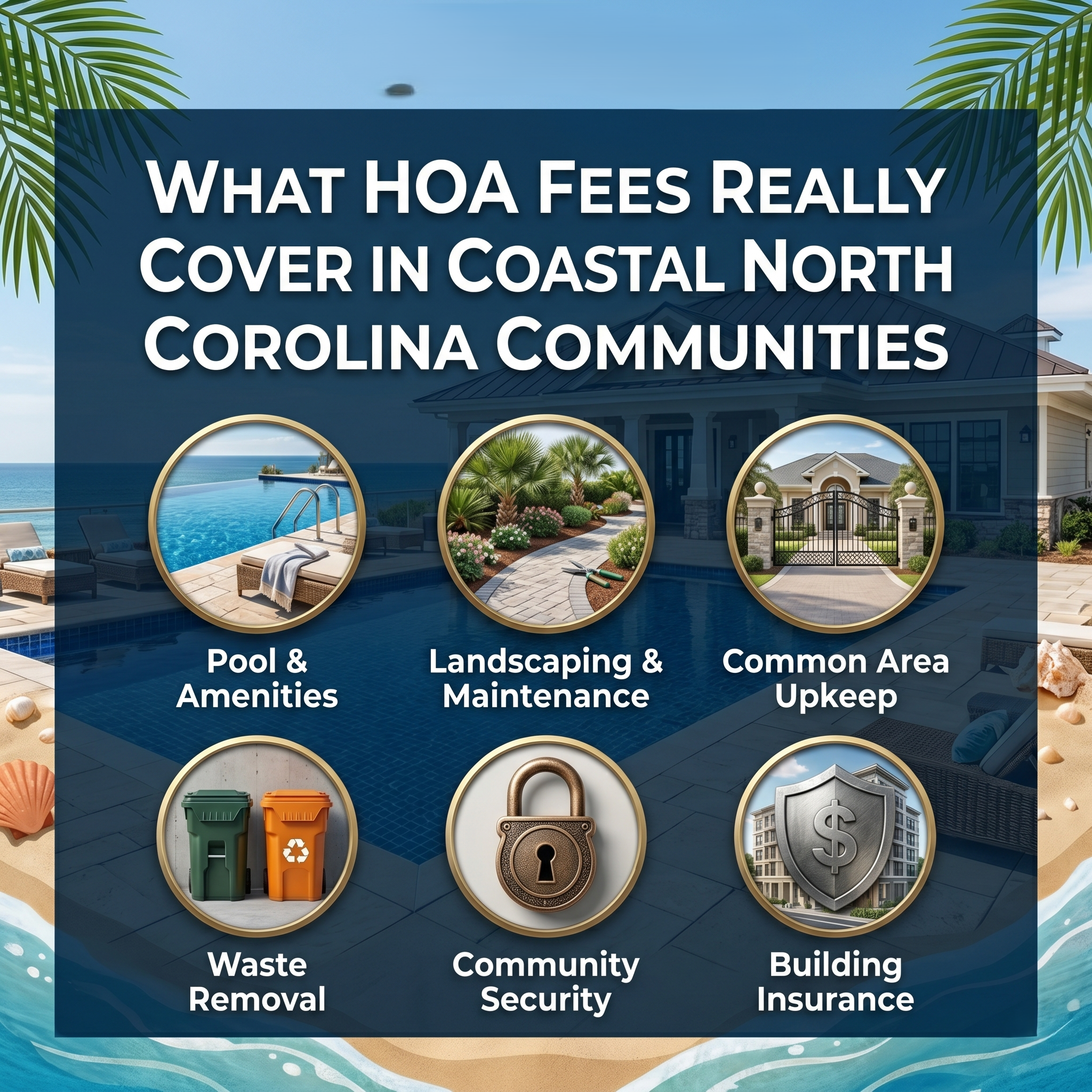
In an amenity community like Brunswick Forest or Compass Pointe, monthly HOA dues typically pay for the front-gate or front-entrance maintenance, common-area landscaping, the clubhouse, the pools, the fitness center, the trails and lakes, and the security or roving patrol if there is one. Some communities also include front-yard mowing on the individual lots.
What single-family HOA dues do not cover: your roof, your siding, your individual yard work beyond what is specifically called out, your homeowners insurance, your wind and flood policies, your private storm prep, or any repairs inside your fence line. Those are entirely on you.
What Condo and Townhome HOA Fees Typically Cover
Condo and townhome fees cover much more — and that is why the dollar amount is so much higher. A condo HOA usually covers the building exterior, the roof, the common hallways and stairwells, master insurance on the structure, exterior pest control, trash, water and sewer in many buildings, and reserves for the big shared systems like elevators, roofs, and parking decks.
In a Wilmington condo, this can include the building envelope plus all common amenities. In an oceanfront building, the master policy alone can be a five-figure annual expense per unit because of wind coverage. That is not the HOA being wasteful — it is the cost of insuring an oceanfront concrete tower in 2026.
The Coastal Reality: Insurance Is Driving Fee Increases
If your HOA fee in coastal NC went up 15 to 30 percent in the last two years, the cause is almost always one of two things: the master insurance policy renewal, or a reserve study that identified an underfunded long-term repair. Wind and hail coverage on coastal structures has moved sharply, and HOAs are passing the cost along the only way they can — through dues.
Ask for the last three years of the operating budget before you buy into any condo or amenity community. The trend line tells the story.
Hidden Costs Buyers Miss
Special Assessments
A special assessment is a one-time charge the HOA levies for a specific project that reserves do not cover. New roofs, balcony replacements, paving, and post-storm repairs are the common drivers. Coastal buildings are particularly exposed, and a special assessment of $5,000 to $30,000 per unit is not unusual after a major storm year.
Master Policy Deductibles
The master policy may have a wind deductible of 2 to 5 percent of the insured value. If a storm damages the building, individual owners often share that deductible. This is something buyers should ask about up front, not learn after closing.
Capital Contribution Fees
Many coastal communities charge a one-time capital contribution at closing — often one to three months of dues, sometimes more. It is not refundable. Read the resale certificate before contract.
What to Ask Before You Write the Offer
Three documents tell you almost everything you need to know about an HOA: the current budget, the reserve study, and the meeting minutes for the last twelve months. The budget shows what is actually being spent. The reserve study shows whether the community is saving enough for the big repairs ahead. The meeting minutes show what residents and the board are actually worried about — leaks, lawsuits, insurance, parking, anything.
If a seller or listing agent cannot produce these, treat that as information too. In a master-planned community like Brunswick Plantation, this paperwork should be readily available.
Key Takeaways
Use the following quick checklist when evaluating a coastal NC HOA:
- The monthly fee number is less important than what the fee includes and what the community has in reserves
- Single-family HOA dues mostly cover amenities and common areas, not your individual home
- Condo and townhome dues cover the building exterior and master insurance, which is why they are higher
- Insurance renewals are driving most of the recent fee increases on the coast
- Always review the budget, reserve study, and meeting minutes before you buy
- Watch for special assessments, master policy deductibles, and one-time capital contributions
Frequently Asked Questions
Are HOA fees tax deductible in North Carolina?
HOA fees on a primary residence are generally not tax deductible. HOA fees on a rental property are typically deductible as a rental expense. Consult your tax professional for your specific situation.
Can an HOA raise my fees without my consent?
Yes, within the limits set by the community's governing documents. Most North Carolina HOAs can raise dues annually up to a stated percentage without an owner vote, but larger increases or special assessments above a threshold usually require owner approval. The bylaws spell out the exact rules.
What happens if I do not pay my HOA dues?
The HOA can charge late fees and interest, suspend amenity access, and eventually file a lien against your property. In North Carolina, an unpaid HOA lien can lead to foreclosure. Always keep dues current.
Do oceanfront condos always have higher HOA fees?
Almost always, yes. The cost is driven by the master wind and flood policies, elevator and parking deck maintenance, salt-air exposure on exterior building components, and the higher reserves required to keep up with that wear. Two identical-looking condo buildings can have very different fees depending on how recently the major systems were replaced.
How can I find out if a community has a healthy reserve fund?
Ask for the most recent reserve study. A funded ratio above 70 percent is generally considered healthy. Below 30 percent is a warning sign that a special assessment may be coming. Your agent should request this in writing during your due diligence period.