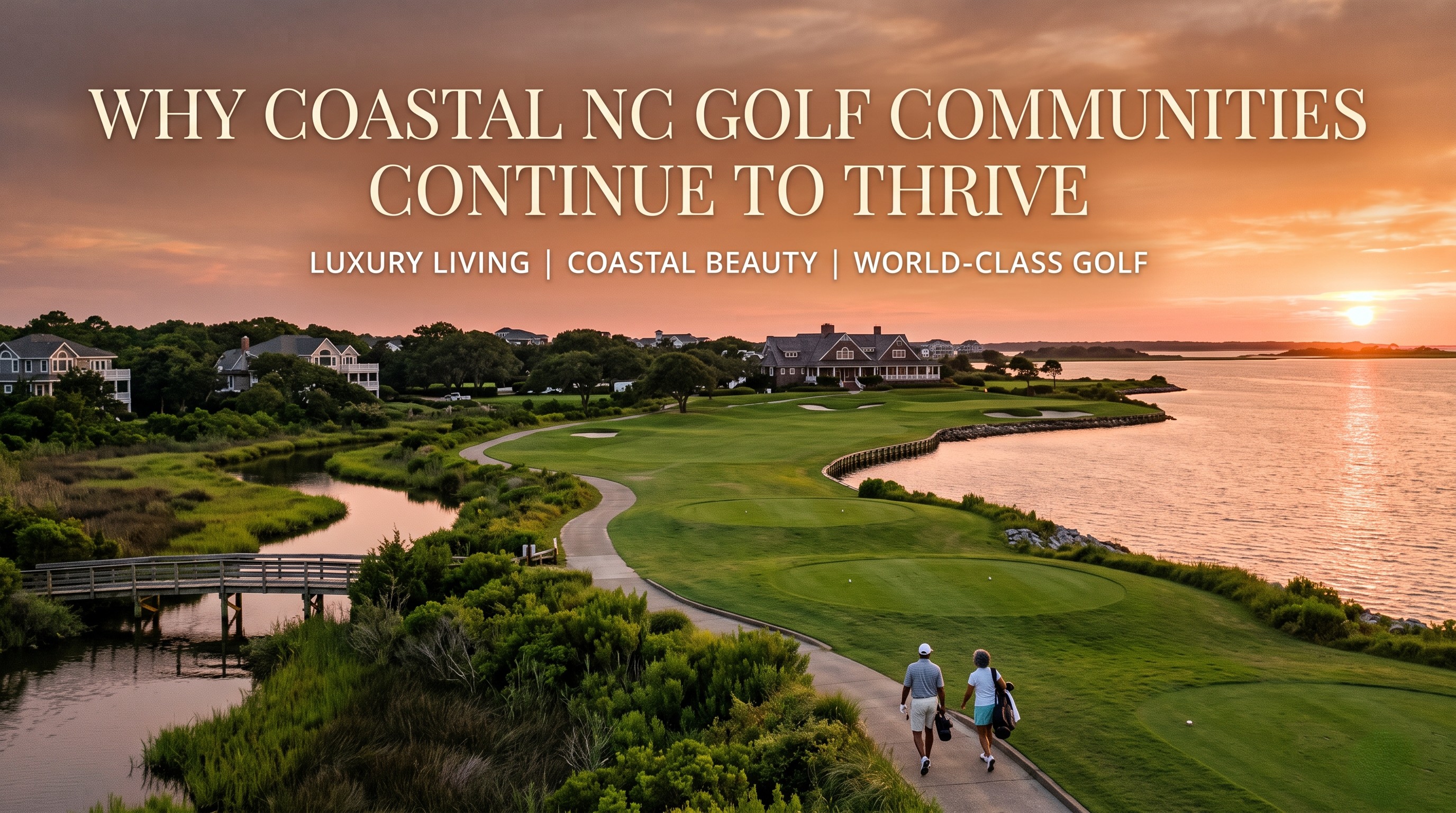
Coastal North Carolina has more golf communities per square mile than most parts of the country. And unlike some regions where golf communities have faded, the coastal Carolina versions keep filling with new buyers year after year. Retirees. Second-home owners. Remote-work households. Empty-nesters downsizing from suburban homes elsewhere. The reasons haven't changed much in twenty years, and neither has the appeal.
Here's what I mean. Golf communities on this coast aren't just golf. They're a specific packaged lifestyle — amenity-rich, socially structured, protected-view neighborhoods with real community continuity — that delivers on a promise a lot of retiring buyers didn't know how to name until they moved into one. Once they experience it, they stay bought.
Why the Model Still Works
Three structural forces keep coastal NC golf communities thriving. First, the retiree in-migration hasn't slowed. Buyers from the Northeast, Midwest, and increasingly Florida keep landing in coastal Carolina every year. Golf communities are one of the most recognized landing pads.
Second, the amenity infrastructure has proven itself. Newer communities that were half-built ten years ago are now mature with active clubs, established restaurants, and functioning event calendars. That maturity is what turns marketing brochures into actual community life.
Third, the specific product — protected green space, gated or semi-gated feel, walkable interior layouts, resort-style pools, tennis and pickleball, dining inside the gates, and a social calendar that fills the year — is genuinely hard to reproduce outside a master-planned framework. Once buyers understand what the model delivers, alternatives feel comparatively empty.
The Leland Cluster
Leland has the highest concentration of coastal NC golf communities. Brunswick Forest anchors the market with Cape Fear National golf, extensive amenities, and integrated retail and medical infrastructure. Compass Pointe delivers gated golf-community living with a slightly more upscale feel. Magnolia Greens offers a public-access golf course with more established neighborhoods and moderate pricing.
The Leland cluster benefits from quick Wilmington access, Brunswick County tax rates, and a broad range of price points across the different communities. Retirees who compared multiple options often land here after touring.
The Southport Anchor
Just south of Wilmington, St. James Plantation delivers four golf courses, a private beach club at Caswell Beach, marinas on the ICW, and one of the largest amenity packages on the coastal NC market. St. James has been thriving for decades and shows no signs of slowing.
Southport-area buyers who want a smaller community footprint often look at Southport-area alternatives in the historic district or smaller subdivisions. But for buyers who want maximum golf and amenity depth, St. James is the anchor.
The Calabash and Sunset Beach Corridor
Further south in Brunswick County, the Calabash area supports multiple golf communities and delivers a lower-cost entry point than the Leland or Southport clusters. Brunswick Plantation offers gated golf-community living. Carolina Shores delivers established neighborhood character around a golf course at more accessible pricing.
The Calabash corridor sits close to Sunset Beach and the South Carolina line, which means residents get easy beach access plus proximity to Myrtle Beach airport for family travel. That combination keeps drawing buyers who don't want to be in the Wilmington-side price bracket.
Landfall in Wilmington
Landfall anchors the Wilmington-side luxury golf market. Gated community, mature streets, championship golf, tennis, and proximity to Wrightsville Beach make it one of the most-recognized addresses in the region. Retirees and second-home buyers who want Wilmington-adjacent luxury with a full amenity package often land here.
What Keeps Buyers Choosing Golf Communities
Predictable Lifestyle
Buyers know what they're getting. The amenity structure, the community calendar, the general feel — these aren't surprises after closing. That predictability is a real value for buyers making a major relocation late in life.
Social On-Ramp
Relocating to a new region without knowing anyone is hard. Golf communities provide immediate social infrastructure. Book clubs, wine groups, women's golf, men's golf, veteran organizations, volunteer boards. Within six months, most engaged residents have built a real social life.
Resale Strength
Well-run golf communities have consistently outperformed the surrounding non-amenity inventory at resale. The amenity infrastructure, the protected green space, the consistent build quality, and the established buyer pool combine into liquidity that some coastal markets don't offer.
Multi-Generational Fit
Grandkids visit and use the pool and beach club. Grandparents host without stressing about entertainment. Multiple generations can co-exist inside the community for a week or a season without the friction of a smaller footprint.
What the Model Isn't
Golf communities aren't for everyone. Buyers who dislike HOAs, dislike gated feel, dislike architectural review, dislike golf, or dislike community calendars won't get value from the amenity dues. The right response for those buyers is a community without amenities and without the associated overhead, not a golf community they'll silently resent.
Practical Financial Considerations
HOA dues, club membership fees, capital contribution charges at closing, and continuing dues increases are all part of golf community ownership math. Buyers should model the full monthly cost, not just the base HOA dues, and plan for 3 to 8 percent annual increases as a baseline.
The Long-Term Outlook
Continued retiree in-migration into coastal North Carolina is the base case for the next several years. Golf community demand is likely to remain strong because the specific product remains hard to reproduce outside master-planned frameworks. Existing communities will continue to mature. Newer communities will keep coming online. Buyers who choose deliberately, model the total cost, and pick a community that matches their actual amenity use will continue to do well.
Key Takeaways
Coastal North Carolina golf communities keep thriving because the specific product they deliver — protected green space, amenity infrastructure, gated or semi-gated community feel, structured social calendar, and resale liquidity — is genuinely hard to reproduce outside master-planned frameworks. The Leland cluster (Brunswick Forest, Compass Pointe, Magnolia Greens) leads the market on volume and price range diversity. St. James Plantation in Southport anchors the region with the deepest amenity package. The Calabash and Sunset Beach corridor delivers lower-cost entry through Brunswick Plantation and Carolina Shores. Landfall in Wilmington anchors the luxury Wilmington-side golf market. Retiree in-migration, matured amenity infrastructure, and the specific packaged lifestyle keep demand strong. Buyers should model total carrying cost — HOA plus club membership plus capital contribution — before committing. The model isn't for buyers who dislike HOAs, gated feel, or golf itself. For buyers who use the amenities and value the community structure, coastal NC golf communities continue to deliver one of the most consistent retirement and second-home experiences available on the East Coast.
Frequently Asked Questions
Do I have to play golf to live in a golf community?
No. Club memberships in most coastal NC golf communities are tiered, and non-golf residents can typically choose a social or sports-only membership. The community amenity structure serves non-golfers well when the membership is chosen accordingly.
Which coastal NC golf community has the best resale performance?
Well-run established communities like Brunswick Forest, Compass Pointe, Magnolia Greens, St. James Plantation, and Landfall have all historically shown consistent resale performance. Specific results vary by property type, location within the community, and market timing.
How much do golf community HOA dues typically run in coastal NC?
Widely variable. Base HOA dues range from roughly $75 to $400 monthly across coastal NC golf communities. Club membership fees add on top, often several hundred to over a thousand dollars monthly depending on tier. Always verify the specific numbers for the community you're considering.
Are there capital contribution fees at closing?
Most master-planned golf communities charge a capital contribution fee at closing, typically ranging from several hundred to several thousand dollars. This fee funds community reserves and generally can't be negotiated away.
Which community should I tour first?
Depends on price point, preferred location, and lifestyle. Brunswick Forest is the largest and most diverse. Compass Pointe is more upscale and gated. St. James Plantation has the deepest amenity package. Landfall anchors Wilmington luxury. Magnolia Greens and Brunswick Plantation deliver more accessible pricing. Tour multiple to see which feel matches your daily life.