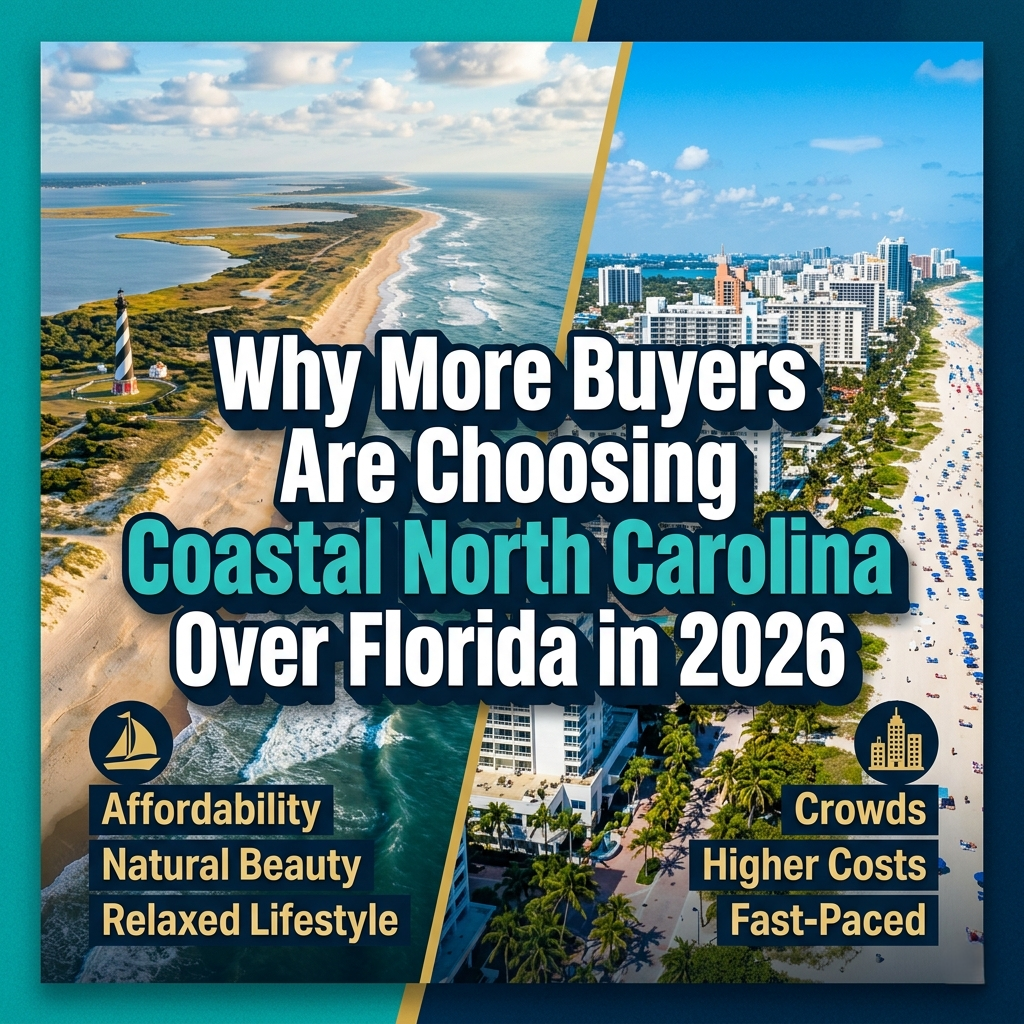
For years, Florida was the default answer when buyers from up north imagined their move to the warm coast. That answer is changing fast. More of the buyers I work with in 2026 are skipping Florida entirely and heading to coastal North Carolina instead, and the reasons are stacking up.
Insurance hikes, hurricane fatigue, rising HOA assessments, and crowded traffic corridors have pushed Florida out of reach for a lot of second-home buyers and retirees who were once locked in on it. Coastal North Carolina is offering most of what those buyers wanted in the first place, often at a lower carrying cost.
What Buyers Liked About Florida — and What Coastal NC Now Offers
Most of the Florida-bound buyers I used to compete with wanted four things: warm weather most of the year, no state income tax or a low tax burden, boating and beach access, and an active community to retire into. Coastal North Carolina checks three of those boxes outright. The fourth, taxes, is closer than people think once you compare property tax bills and insurance premiums side by side.
A buyer purchasing a $750,000 single-family home in Wilmington is often paying less in combined taxes and insurance than the same buyer would in Naples or Jupiter. The gap has widened every year since 2022.
Insurance and Storm Risk
The Florida property insurance market has been the loudest reason buyers are walking. Premiums on coastal Florida homes have doubled and tripled in some counties, and several national carriers have pulled back from writing new policies. North Carolina is not immune to wind and hail, but our market is still functional. Buyers can quote a policy, get bound, and close on schedule.
Flood zones still need careful review here, and storm prep matters. The difference is that a buyer purchasing in Wrightsville Beach or Carolina Beach can typically secure both wind and flood coverage without the seven-page disclosures and surcharges Florida has rolled out.
Lifestyle and Crowding
Florida's growth has caught up with it. Roads that handled traffic fifteen years ago are gridlocked. Restaurants take an hour to seat you in season. Even quiet inland towns have filled in. Buyers tell me they want coastal living, not constant lines.
The Wilmington area still feels like a beach town. Wrightsville Beach is a twenty-minute drive from downtown. Carolina Beach has a small-town pier-and-boardwalk feel. Restaurants seat you on a Saturday night without a six-week reservation. That is not a small thing for a buyer leaving New Jersey or Long Island to slow down.
Cost Per Square Foot
New Construction
New construction in coastal NC is still meaningfully cheaper than equivalent new builds in Naples, Bonita Springs, or the Treasure Coast. Buyers who would have stretched for 1,800 square feet in a Florida 55-plus community can often land 2,400 to 2,800 square feet in a comparable amenity-rich Brunswick County community.
Resale Inventory
The resale market here is also more forgiving. Florida resale inventory has bloated as homeowners try to sell out of high insurance and HOA costs, but pricing has stayed elevated. Coastal NC resale homes have moved gently in 2026 and the negotiating room is fairer for buyers without being a fire sale for sellers.
Where Florida Buyers Are Landing
The Wilmington area, Brunswick County, and the Topsail and Surf City corridor are picking up the largest share of these relocations. Within Wilmington proper, buyers gravitate to walkable Historic Downtown, midtown, and the Mayfaire area. Brunswick County draws the amenity-community shoppers. Brunswick Forest in Leland, St. James Plantation in Southport, and Compass Pointe all routinely beat Florida options on monthly carrying cost.
Hampstead, between Wilmington and Surf City, is grabbing buyers who want easy boat access without paying oceanfront prices. Sneads Ferry is another quiet winner for retirees and remote workers leaving Florida.
Where Florida Still Wins
Florida is not losing every buyer. If you want consistent warmth in January and February, Florida holds that edge. Coastal NC has real winter weeks, even if our winters are mild compared to most of the country. Some buyers also want the deeper professional sports and theme park infrastructure that Florida has built up over the years.
But for most retirees, second-home buyers, and remote-work families who care more about lifestyle and cost than late-January beach weather, the math has shifted.
Key Takeaways
Coastal North Carolina is winning Florida-bound buyers because the cost of insurance, the cost of housing per square foot, and the daily quality-of-life math have all tilted away from Florida and toward us. Wilmington and Brunswick County offer most of the lifestyle Florida buyers came south for in the first place — boating, golf, walkable communities, mild winters — without the runaway insurance premiums or the crowding. The buyers leaving Florida are not unhappy with the coast; they are unhappy with what owning on the Florida coast now costs. North Carolina is collecting the rest of the trade.
Frequently Asked Questions
Is property insurance cheaper in coastal North Carolina than in Florida?
In most coastal counties, yes. A typical single-family home a few blocks off the water in Brunswick or New Hanover County will see a combined wind and hail policy at a fraction of what coastal Florida is quoting in 2026. Flood insurance through the NFIP is priced similarly in both states, but private wind coverage is the main savings driver.
Does North Carolina have a state income tax?
Yes, North Carolina has a flat state income tax. Florida does not. However, when you factor in lower property insurance, lower homeowners costs, and generally lower property taxes per dollar of home value on the coast, retirees and remote workers often net out close to even or ahead in North Carolina.
How does the property tax burden compare to Florida?
Property tax rates in coastal North Carolina counties are competitive. New Hanover, Brunswick, and Pender counties all run effective rates that compare favorably to many Florida coastal counties once you add in special districts. Buyers should always compare the full annual tax bill on a specific home rather than headline rates.
Is the hurricane risk really lower in coastal NC?
Hurricane risk exists in both states, but the frequency and intensity profile is different. Florida sits in a much more active strike zone over a given decade. Coastal NC homes still need proper storm prep, but insurers price the risk lower and policy availability is more stable.