Wilmington NC Real Estate Blog | Market Trends & Relocation Guides

Stay informed on the Wilmington, NC real estate market with our latest blog updates. From detailed relocation guides and neighborhood spotlights to expert investment strategies and local market forecasts, we provide the essential information you need to navigate the coastal Carolina lifestyle with confidence. Explore our recent posts to start your journey toward finding the perfect home in the Port City.

July 29, 2026

How Flood Zones Affect Home Prices Along the North Carolina Coast

Every buyer on the coastal North Carolina market eventually runs into flood zones. The FEMA-issued designations that label a property as X, AE, VE, or something more specific look bureaucratic on paper and are actually one of the single largest factors driving what a home costs, what it costs to insure, whether a lender will finance it, and how it sells at resale. Buyers who understand flood zones make sharper decisions. Buyers who do not sometimes buy a beautiful home and inherit a carrying-cost problem they never accounted for.

Here is the honest picture of how flood zones actually affect home prices along the coast — Wrightsville Beach, Carolina Beach, Oak Island, and the broader Wilmington region.

What the Flood Zone Labels Actually Mean

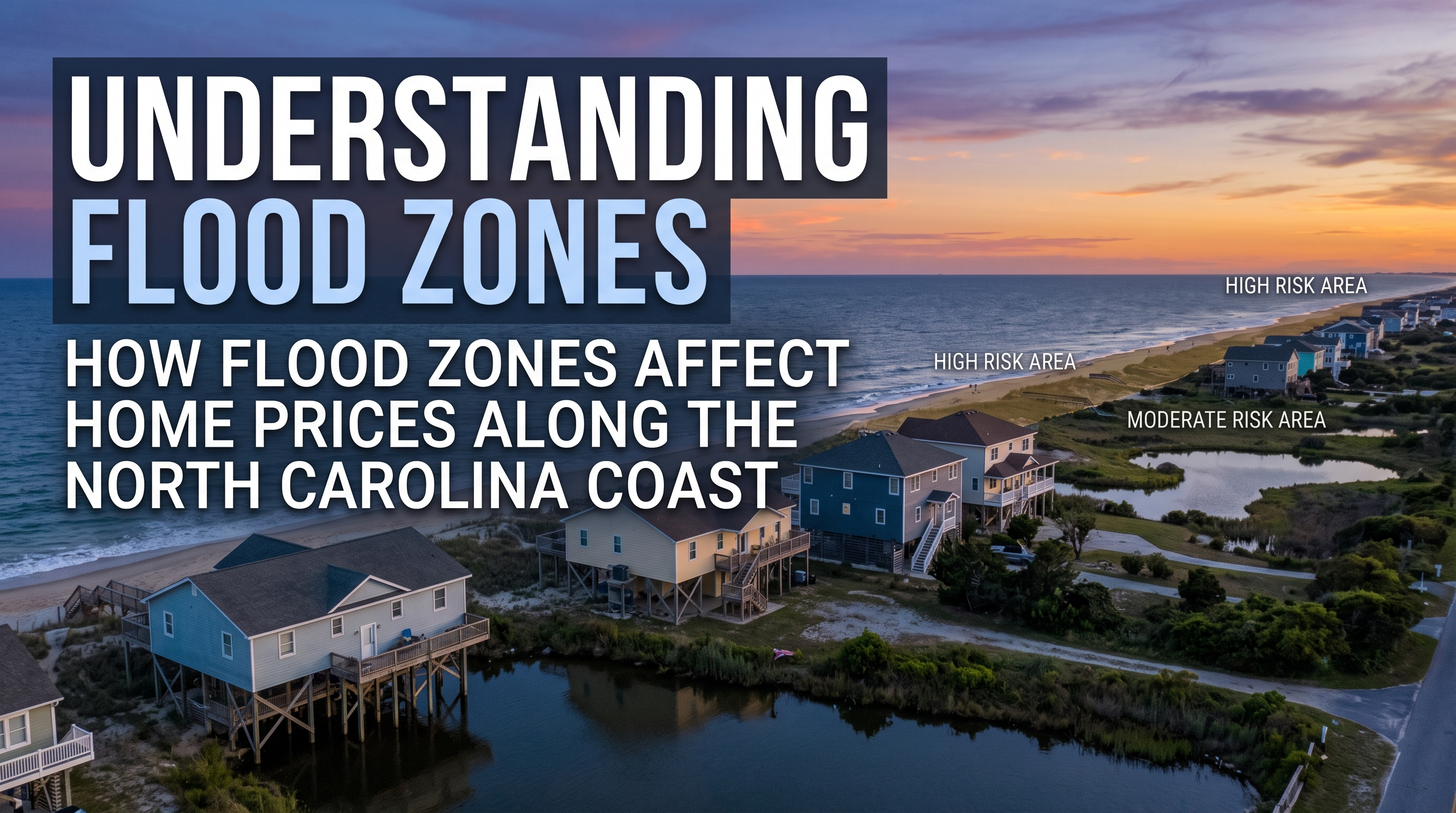
FEMA divides property into flood risk zones based on modeled base flood elevations, storm surge scenarios, and historic data. Zone X, sometimes labeled "shaded X" or "unshaded X," represents the lowest flood risk — either outside the modeled 100-year floodplain or in the 500-year floodplain. Zones A and AE indicate high-risk areas within the 100-year floodplain, with AE providing a specific base flood elevation for insurance and construction purposes. Zone VE indicates high-risk coastal areas with wave action, typically along oceanfront and near-inlet properties. Each label carries different insurance and lending implications.

Buyers should always pull the current flood determination on a specific property. The zone can vary block by block, and the label on a listing description is not always current or accurate.

How the Zone Affects the Home Price

The zone shows up in the sale price through several channels. The most direct is flood insurance cost. Homes in AE and VE zones require flood insurance for any federally backed mortgage, and the annual premium can range from $600 for a well-elevated home in a favorable AE zone to $5,000 or more for a poorly elevated home in an aggressive VE zone. That premium is a real recurring cost that buyers price into what they will pay.

The second channel is elevation compliance. Homes built or substantially improved in an AE or VE zone are required to meet base flood elevation standards. Older homes that predate the current standards may be grandfathered but face renovation and rebuild restrictions that reduce future flexibility. Buyers looking to renovate significantly should understand the "substantial improvement rule," which triggers full compliance if the improvement exceeds 50 percent of the pre-improvement value.

Zone X: The Quiet Advantage

Homes labeled X sometimes trade at a premium for what feels like an intangible reason — buyers simply prefer them. The financing is straightforward, flood insurance is optional, elevation compliance is not required, and daily peace of mind is higher. Even a few blocks of inland shift can move a property from AE to X, and that shift can be worth meaningful money at resale.

Buyers should not assume Zone X means no flood risk. Some of the most expensive coastal flood claims come from properties outside the highest-risk zones. Flood insurance in Zone X is affordable and is generally worth considering even when it is not required.

Zone AE and VE: Where the Math Gets Detailed

In AE and VE zones, the specific elevation of the finished floor relative to the base flood elevation matters. A home built two feet above BFE quotes far better than a home built at BFE or below. Buyers should ask for an elevation certificate on any home they are considering in AE or VE, and if one does not exist, plan for an elevation survey during diligence.

The math often works. A well-elevated AE or VE home in a desirable coastal location can still trade at premium prices, and buyers who understand what they are pricing tend to come out well. What kills value is a poorly elevated home with unclear compliance status and a large insurance quote — that combination becomes a discount property fast. 
How Flood Zones Affect Home Prices Along the North Carolina Coast

How Zones Affect Lending

Federal law requires flood insurance for any federally backed mortgage on a home in a Special Flood Hazard Area (SFHA), which includes AE and VE zones. Cash buyers can technically skip the insurance in these zones, but doing so is rarely advisable given the exposure. Some lenders have additional overlays that affect underwriting, especially on older homes with unclear elevation compliance.

Resale and Long-Term Value

Homes with clear flood zone documentation, current elevation certificates, and manageable insurance quotes resell more easily than homes with murky zone histories. Buyers ask harder questions than they did five years ago, and unresolved flood questions consistently slow deals. Sellers of homes in AE and VE zones should proactively assemble the documentation before listing.

Homes that have flooded in the past face additional scrutiny. North Carolina requires disclosure of known flood history, and prior claims show up on the CLUE report. This is not a dealbreaker, but it is information that affects both price and financing.

Neighborhood-Level Variation

Flood zones can vary block by block. A home on the higher side of a beach town street may sit in Zone X while a home a block away sits in AE. Even within the same street, drainage patterns, natural elevation, and construction era can produce meaningful differences. This is one of the reasons buyers should treat flood determination as property-specific, not neighborhood-specific.

Practical Steps for Buyers

Pull the current FEMA flood determination on any property being considered — this is inexpensive and quick. Quote flood insurance during due diligence, not after. Request the elevation certificate if the home is in AE or VE. Ask about prior claims and prior flooding. Look at the property in a heavy rain if possible. Match the total carrying cost against the buyer's budget rather than the sticker price alone. These steps together turn what feels like a bureaucratic layer into practical information.

Practical Steps for Sellers

Assemble the flood documentation before listing. Pull the current determination, locate or commission the elevation certificate, gather any prior claim documentation, and be ready to hand it all to a buyer's agent on request. Sellers who have their flood story organized close deals faster and negotiate better than sellers who do not.

Key Takeaways

Flood zones are one of the biggest single drivers of coastal North Carolina home value, and yet many buyers spend less time understanding them than they spend picking paint colors. The FEMA-issued zone determines whether flood insurance is required, how much it costs, whether elevation compliance applies, and how the home will sell in the future. Zone X properties often trade at quiet premiums for the flexibility and peace of mind they deliver. Zones AE and VE can absolutely trade well when the home is well-elevated, the documentation is complete, and the insurance math is reasonable. What consistently hurts pricing is unresolved documentation, unclear elevation status, prior claims that were not disclosed cleanly, or an insurance quote that arrives late in the process. Buyers who pull the flood determination early, request the elevation certificate, quote insurance during due diligence, and factor the true carrying cost into their offer consistently make good decisions. Sellers who organize their flood documentation before listing sell faster and closer to ask. Flood zone information is one of the highest-leverage things a buyer or seller can master on this coast, and it costs almost nothing to master.

Frequently Asked Questions

How can I find out what flood zone a specific home is in?

The FEMA Flood Map Service Center (msc.fema.gov) provides free lookup by address. Local county GIS systems also display flood zones. Your buyer's agent should pull the current determination during initial diligence, not after contract.

Does flood insurance transfer with the property?

NFIP flood policies can be assumable in some cases, which can be valuable if the seller has an older policy at a favorable rate. Your agent and insurance agent should confirm whether the specific policy transfers and whether it is worth taking over.

Do I need flood insurance in Zone X?

Lenders do not require it in Zone X, but many owners still carry it because premiums are modest and coverage is meaningful. Some of the most expensive flood claims come from properties outside the highest-risk zones.

How much does an elevation certificate cost?

Typically $400 to $800 for a coastal NC home. Sellers sometimes have one on file. If not, buyers can commission one during due diligence, and the cost is often recouped in reduced insurance quotes if the elevation is favorable.

Can flood zones change over time?

Yes. FEMA updates flood maps periodically as new data becomes available. Homes that were previously in one zone can be remapped into another. Buyers should always use the current determination rather than relying on older documentation from the seller.

Posted in For Buyers
July 28, 2026

Small-Town Living Near Wilmington: Burgaw Real Estate Guide

Drive twenty-five miles north of Wilmington on Highway 117 or up US 17 and you land in Burgaw. The county seat of Pender County, Burgaw is small enough to walk end to end and old enough to feel like it grew rather than was planned. For buyers who want coastal-region access without coastal-region density or price points, Burgaw has quietly become one of the more interesting alternatives on the Wilmington outskirts. Retirees, remote workers, families looking for more land, and buyers who want a small-town feel without moving hours from a real city all keep landing here.

Here is a practical guide to the Burgaw real estate market — who is buying, what is available, what to know, and how Burgaw compares to the other options a Wilmington-area shopper is considering.

What Makes Burgaw, Burgaw

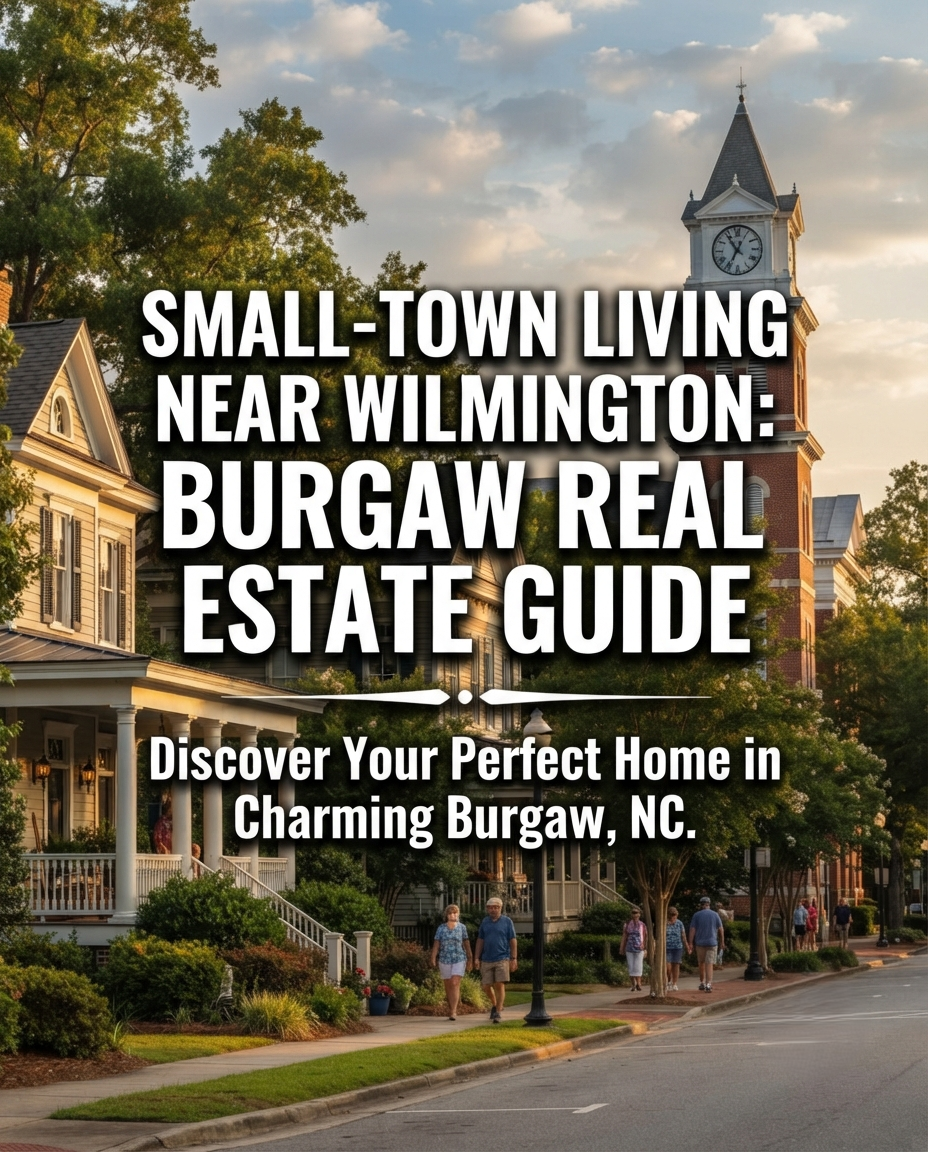
Burgaw's identity is anchored by a historic downtown around the 1936 Pender County Courthouse, the surrounding brick storefronts, the Burgaw Historic District, and a genuine small-town rhythm that has resisted the sprawl of most of the region. The town hosts the North Carolina Blueberry Festival every summer, a Christmas parade that shuts down Fremont Street, and a weekly farmers' market that draws vendors from across the county. The population sits under four thousand, which is small enough that residents know their neighbors and large enough to support a functional downtown, groceries, restaurants, medical, and services.

Who Is Actually Buying in Burgaw

The Burgaw buyer pool has three main groups. Wilmington-area residents who want more land, quieter streets, and a lower carrying cost, and who are willing to drive thirty to forty minutes for the trade. Retirees relocating from the Northeast or Midwest who want a small town over a beach or master-planned community. Remote-eligible professionals who can work from anywhere and want a lower cost of living plus a slower pace than Wilmington proper. A smaller but real fourth group — investors and buyers seeking working farm or acreage — round out the profile.

The Housing Stock

Historic Downtown Homes

Burgaw's downtown blocks include restored 19th- and early-20th-century homes with deep front porches, mature landscaping, and walking access to the courthouse square. Inventory is thin because owners rarely sell, and pricing reflects the scarcity. Buyers who want the walkable-downtown feel should be ready to move on the right home when it appears.

New Construction and Newer Neighborhoods

New construction inventory has grown in and around Burgaw over the last several years, delivering three- and four-bedroom single-family homes on quarter-acre to half-acre lots at price points meaningfully below Wilmington-proper and Hampstead equivalents. Builders have targeted the affordability-conscious relocating buyer and the young family market.

Farms and Acreage

Burgaw sits in a rural county with an active agricultural history. Small farms, larger tracts, and homes on multi-acre lots remain available at price points that are becoming increasingly rare within a 45-minute drive of Wilmington. Buyers who want land, room for animals, or a homestead lifestyle often find what they are looking for here more than anywhere else in the region.

Burgaw Real Estate Guide

Access and Practical Considerations

Wilmington Commute

Burgaw is roughly 30 to 40 minutes from central Wilmington depending on traffic and specific destination. The commute is real but manageable for a hybrid worker with occasional in-office days. Full-time daily commuters should test the drive at rush hour before committing.

Beach and Coast Access

Topsail Island and Surf City are roughly 30 minutes east. Wrightsville and Carolina Beach are 45 to 50 minutes. Burgaw is not on the coast, but the coast is reachable for a beach day without an overnight.

Airport

Wilmington International (ILM) is roughly 30 minutes south, meaning Burgaw remains accessible for travel-heavy remote workers.

Schools

Pender County Schools serve Burgaw. Local families should verify specific school assignments and evaluate the district based on the specific home rather than the county reputation.

Healthcare

Pender Memorial Hospital is in Burgaw proper. More specialized care is available at Novant Health New Hanover Regional in Wilmington, roughly 30 minutes south.

Property Taxes

Pender County property tax rates are competitive. Buyers inside Burgaw town limits carry an additional municipal rate; buyers in unincorporated Pender County outside town limits pay only the county rate. The gap is meaningful on annual bills.

How Burgaw Compares

Vs. Wilmington

Burgaw trades urban convenience for a lower cost, a small-town feel, and more space per dollar. Buyers who need the Wilmington cultural scene and daily infrastructure will find Burgaw quiet. Buyers who value quiet find it exactly what they wanted.

Vs. Hampstead

Hampstead delivers coast plus city access. Burgaw delivers quiet plus city access. Both draw families and remote workers, but the daily lifestyle differs. Hampstead is closer to the beach; Burgaw is closer to farmland.

Vs. Leland

Leland offers master-planned amenities, gated communities, and easy Wilmington access. Burgaw offers small-town character, land, and a slower pace. Buyers choose based on lifestyle preference rather than price alone.

Vs. Beach Towns

Beach towns deliver coastal living every day. Burgaw delivers coastal-region access without paying beach-town carrying costs. For buyers who value land and quiet over a walk to the surf, Burgaw wins the value math.

Community and Culture

Small towns thrive or die based on their community infrastructure. Burgaw has a functional downtown, active civic and church organizations, a genuine farmers' market culture, and community events that residents actually attend. The Blueberry Festival draws tens of thousands each summer. First Friday events in downtown Burgaw draw locals and visitors. Volunteer opportunities are plentiful for retirees who want to be involved.

Lifestyle Fit

Burgaw fits buyers who value quiet over convenience, community over anonymity, land over amenities, and character over new. It does not fit buyers who need walkable urban infrastructure, immediate beach access, or a busy social calendar within a five-minute drive. The honest self-assessment before touring homes here is worth the time — Burgaw rewards the right buyer and quietly disappoints the wrong one.

What Buyers Should Ask During the Search

Where is the specific home in relation to town limits, and what does the total tax bill look like? What is the internet infrastructure at the address (particularly for remote workers)? What are the specific schools assigned to the home? What is the drive to the specific Wilmington destination the buyer will visit most often? Is the home on public water and sewer, or well and septic? Each answer changes the ownership picture, and each is easy to verify before contract.

Long-Term Outlook

Burgaw's growth has been steady rather than explosive. That measured pace is likely the future too. New construction will continue delivering incrementally. Downtown will retain its character. The population will grow moderately. Buyers who love Burgaw for what it currently is will find that Burgaw stays largely the same, which is often exactly what they came for.

Key Takeaways

Burgaw offers something increasingly rare in the coastal North Carolina region — real small-town character, historic downtown blocks, active community life, land, and lower cost of living, all within a reasonable drive of Wilmington, the airport, and the beaches. Buyers land here because they want quiet over convenience, land over amenities, and the feel of a real town over the polish of a master-planned community. The historic downtown inventory is thin and pricing reflects it. New construction and near-town homes offer the best value for relocating buyers who want modern finishes at accessible prices. Farms and acreage remain available for buyers seeking land, which is genuinely hard to find closer to Wilmington. Practical considerations — the Wilmington commute, school assignment, well and septic if applicable, and municipal versus unincorporated tax status — all deserve attention. Buyers who match themselves to Burgaw's specific lifestyle end up quietly happy. Buyers who chose it primarily for price without evaluating the fit sometimes discover the tradeoffs aren't worth the savings. Burgaw rewards the buyer who actually wants a small town near Wilmington — and it disappoints anyone shopping only on numbers.

Posted in Carolina Lifestyle
July 27, 2026

How to Prepare Your Coastal Home Before Storm Season

Storm season on the North Carolina coast is not a crisis. It is an annual rhythm that every coastal homeowner learns eventually. The owners who ride it out best are the ones who treat preparation as a routine — spread across months, not compressed into the 48 hours before landfall. The owners who struggle are almost always the ones who wait. After watching many storms come and go along Wilmington, Wrightsville Beach, and the Brunswick beaches, here is the practical, no-drama preparation guide that works for a typical coastal NC home.

What Storm Season Actually Looks Like

The Atlantic hurricane season runs June 1 through November 30. On this coast, June and July are typically quiet. Late August through mid-October is the active window, with the third week of September historically the highest-risk stretch. November brings occasional late-season systems, usually weakening as they approach. Most years pass with one or two systems that affect the region in minor ways. Occasionally a serious storm arrives. Preparation should assume the serious storm can come this year even when it usually does not.

What to Do in May and Early June

The heaviest lift is at the start of the season. Insurance should be reviewed and any renewals or updates completed. Wind, hail, and flood policies all need to be in force well before any named storm — flood coverage in particular has a 30-day waiting period. A professional tree assessment and pruning of any branches over the house, driveway, or power lines is one of the highest-value annual investments a coastal homeowner makes. Cleaning gutters, downspouts, and site drainage prevents most rainwater damage before it starts. Roof inspection and repair of any minor issues protects against the compounded damage of wind and driven rain.

The other May job is inventory. A phone walkthrough of the house — every room, every closet, every drawer, appliances, art, electronics, high-value items — creates a claim-ready record that costs ten minutes and can save weeks after a serious storm.

What to Have Ready by Mid-July

Shutters, plywood panels, or impact-rated windows should be in place, staged, and rehearsed. If storm-shutter deployment is the plan, the owner should have physically installed a set by mid-July, not learned the process during a storm watch. Emergency supplies — water, non-perishable food for seven days, medications, batteries, flashlights, portable phone chargers — should be stocked. Important documents should be scanned to cloud storage. If a generator is part of the plan, it should have been serviced, run under load, and fueled up. The car should be maintained and gas topped off.

What to Do Three to Five Days Before a Named Storm

Watch the National Hurricane Center directly rather than social media. Update on the cone twice a day and read the discussion sections that explain forecast uncertainty. This is when serious owners run their pre-storm checklist. Fuel up vehicles. Confirm the generator runs. Refill prescriptions. Confirm the evacuation plan for the household — where you go, how you get there, what you take. Pull outdoor cushions in from screened porches. Move loose items in the yard that could become projectiles. Confirm that neighbors and family know your plan.

What to Do 48 Hours Before Landfall

This is when shutters go up. Outdoor furniture, grills, planters, and anything not tied down comes inside. The boat gets moved to an inland storage yard or secured at the dock with extra lines. Freezers get bagged ice. Trash cans come in. Any loose gutters, screens, or fence panels get reinforced or removed. If the household is evacuating, bags are packed, the pet plan is set, and important documents are with the evacuation kit.

What to Do 24 Hours Before Landfall

Decisions have already been made. Evacuation orders should be followed for barrier-island and low-lying communities — Brunswick County and New Hanover County take these decisions seriously and residents should too. Bathtubs get filled for utility water. Every device is fully charged. The freezer and refrigerator are set to their coldest settings. The house is buttoned up. Outdoor plants have been moved to the leeward side.

During the Storm

Stay inside. Do not go outside during the eye — the calm passes and the winds return from the opposite direction. Keep away from windows even if they are shuttered. If flooding rises, move to higher floors. Watch local emergency communications on a battery-powered radio if power is out.

After the Storm Passes

Wait for the all-clear from local officials before going outside. Watch for downed power lines, standing water hiding hazards, and gas leaks. Photograph all damage before any cleanup begins — insurance adjusters value pre-cleanup documentation. Open claims quickly. If the home is uninhabitable, additional living expense coverage in most homeowners policies pays for temporary housing during repairs. Preserve receipts.

How to Prepare Your Coastal Home Before Storm Season

Regional Variations

Barrier Islands and Beach Towns

Barrier-island residents face higher wind and surge exposure than mainland residents, and evacuation orders are usually issued earlier. Buyers on Oak Island, Wrightsville Beach, Carolina Beach, and the Topsail corridor should build the evacuation plan into their routine annual preparation.

Mainland Wilmington and Brunswick County

Mainland exposure tends to be more about tree damage, power outages, and inland flooding than about direct surge. Homeowners should focus preparation on tree work, power backup, and drainage protection.

Waterfront Homes on the ICW and Creeks

Waterfront homes face wind, flood, and surge combinations that inland homes do not. Boats need a specific plan. Docks and bulkheads should be checked for pre-storm integrity. Flood coverage should be confirmed with the actual policy in hand.

What Not to Do

Do not wait until the storm is named to start preparation. Do not assume Zone X means no flood risk. Do not try to obtain flood insurance in the days before landfall — the 30-day waiting period makes it impossible. Do not evacuate too late. Do not stay in a home in an evacuation zone. Do not open claims incompletely — take pictures first, document everything, and work with a licensed adjuster.

Long-Term Improvements Worth Considering

Impact-rated windows and doors reduce risk meaningfully and often earn insurance discounts. Roof hardening and hurricane straps on older homes deliver both safety and financial benefits. A whole-home generator is a genuine quality-of-life improvement for full-time residents, less so for seasonal owners. Elevation improvements on flood-zone homes can lower insurance premiums and reduce risk simultaneously. Each is a real capital investment; the right choice depends on the home and the owner's plans.

Key Takeaways

Preparing a coastal North Carolina home for storm season is a year-round rhythm rather than a crisis-week scramble. The heaviest lifting — insurance review, tree work, gutter cleaning, roof inspection, and inventory documentation — happens in May and early June. Storm supplies, shutters, and generator readiness should be in place by mid-July. Once a storm is named, the timeline tightens fast, and the difference between a smooth ride and a difficult one is how much was already done before the cone first appeared. Evacuation decisions for barrier-island and low-lying communities should be taken seriously each time, not selectively. Mainland Wilmington faces a different risk mix dominated by tree damage and inland flooding. Waterfront and ICW-front homes need boat plans, dock checks, and confirmed flood coverage. Most years on this coast pass without major damage to well-prepared homes. The owners who quietly ride out storm season every year are the ones who treat preparation as a routine annual project — modest, predictable, and largely finished before the season peaks. Coastal ownership rewards the small consistent work far more than it rewards last-minute effort, and storm preparation is one of the clearest examples of that pattern in the region.

Posted in For Buyers
July 24, 2026

How Rising Insurance Costs Are Changing the Coastal Housing Market

Insurance has become the quietest but most consequential force reshaping the coastal North Carolina housing market. Over the last five years, wind and hail premiums have moved up in most years. Flood insurance has repriced under federal NFIP changes. Carriers have tightened underwriting, non-renewed policies, and in some cases exited coastal markets. None of these shifts arrived with a headline, but together they have changed how buyers shop, how sellers price, and which submarkets are winning and losing.

Here is the honest picture of what rising insurance costs are actually doing to the coastal NC market in 2026, drawing on what we are seeing every week in Wrightsville Beach, Oak Island, Carolina Beach, and the broader Wilmington region.

What Has Actually Changed

Premium Levels

Wind and hail premiums on the NC coast have moved up meaningfully since 2020. Oceanfront homes that quoted $3,500 to $5,000 a year in 2020 now regularly quote $6,000 to $12,000 or more. Homes a few blocks inland have seen smaller but real increases. The trend has been steady rather than sudden, which has masked how much has moved.

Deductible Structures

Percentage deductibles on wind and hail policies have grown more prominent, and the percentages themselves have crept higher. A 5 percent wind deductible on a $1 million home is $50,000 out of pocket before the policy pays. Buyers and existing owners are increasingly encountering this structure, and it changes how ownership is planned.

Underwriting Rules

Carriers have tightened underwriting on roof age, prior claims history, distance to coast, and construction type. A home with a 20-year-old roof that was insurable in 2020 may not be insurable under preferred terms today without a replacement.

Carrier Exits

Several national carriers have quietly reduced their coastal NC exposure. The state-run Beach Plan has taken on more policies as private markets have narrowed. Independent agents with access to remaining private markets have become more valuable to buyers.

How This Is Changing Buyer Behavior

Insurance Quotes Earlier in the Process

Sophisticated buyers now quote insurance during due diligence, not after loan approval. Surprise premiums that surface in the final underwriting week have killed enough deals that the market has adjusted.

More Attention to Roof Age

Buyers now ask about roof age up front. Homes with roofs older than 15 years increasingly face a de facto price adjustment because the buyer will need to plan for replacement to secure preferred insurance rates.

Distance-to-Coast Sensitivity

The price gap between homes right on the water and homes a few blocks inland has widened as the insurance math has amplified. A comparable home a half-mile from the beach can now save the owner several thousand dollars a year in premiums compared to the equivalent home directly on the water.

Rethinking Vacation Rental Math

Investors have re-underwriting rental properties as insurance has climbed. Some marginal STR investments no longer pencil out. Investors are moving toward larger, better-located properties that can absorb the premium hit while still producing acceptable returns.

How Rising Insurance Costs Are Changing the Coastal Housing Market

How This Is Changing Seller Behavior

Roof Replacement Before Listing

Sellers with aging roofs are increasingly replacing them before listing to protect the transaction and the buyer's insurance quote. The math often supports the investment.

Documentation of Hardening

Sellers with impact-rated windows, hurricane straps, and roof-to-wall connection documentation are highlighting those features. Verified hardening features can be worth real money at resale because they reduce the buyer's insurance costs.

Realistic Pricing on Older Homes

Sellers of older coastal homes with deferred maintenance are having to price them realistically. The buyer's total carrying cost — mortgage plus taxes plus insurance plus repairs — has moved up faster than sticker prices, and the market is pricing the difference in.

Which Submarkets Are Winning and Losing

Winning: Inland Coastal Communities

Communities that are near the coast but not on it have benefited. Hampstead, Leland's inland sections, Burgaw, and Shallotte all offer coastal-region access with lower insurance profiles than beachfront alternatives. Buyers priced out of oceanfront insurance math are moving into these markets.

Winning: Well-Built New Construction

Homes built to current codes with documented hardening features have advantages that older homes do not. Buyers can insure them more easily, at better rates, and with less friction.

Under Pressure: Older Oceanfront Homes

Older oceanfront homes with 15- to 25-year-old roofs and no hardening upgrades are the most challenged inventory in the market. Sellers face a real choice — invest in upgrades before listing or price accordingly.

Under Pressure: Aging Condos With Rising Master Insurance

Some coastal condo buildings have seen master insurance premiums move up sharply, which flows through to HOA dues. Owners are seeing 10 to 30 percent HOA increases in some buildings, which has affected resale pricing.

What Buyers Should Do Now

Quote insurance on every candidate property during due diligence. Use an independent agent who actively writes coastal NC wind and flood business. Ask about roof age, prior claims, and hardening features on every property. Build the actual carrying cost into your budget rather than the sticker price. Focus on submarkets and property types that insure well rather than assuming the market average.

What Sellers Should Do Now

Confirm your current policy's premium, deductible, and roof-related conditions. Consider roof replacement or documented hardening before listing if applicable. Provide the buyer with your CLUE report and existing policy details to smooth their diligence. Price the home realistically for the insurance math the buyer is running, not for last year's math.

The Longer-Term Outlook

Premium increases are unlikely to reverse quickly. The underlying drivers — climate exposure, reinsurance costs, and rebuilding costs — all point toward continued pressure. Buyers and sellers should assume premiums will keep rising at 3 to 8 percent a year on average, with the possibility of larger jumps in years following major storm activity. That said, the market is adapting rather than breaking. Buyers are still buying. Sellers are still selling. Prices in most submarkets are still holding or rising modestly. The insurance environment is a real headwind but not a market-ending one.

Key Takeaways

  • Wind and hail, flood, and homeowners premiums on the coastal NC market have moved up meaningfully since 2020 and continue to climb in 2026
  • Percentage deductibles on wind coverage — often 2 to 5 percent — mean tens of thousands of out-of-pocket exposure before the policy pays
  • Underwriting has tightened, especially on roof age, prior claims, and distance to coast
  • Buyers are quoting insurance during due diligence, paying closer attention to roof age, and looking further inland for better carrying-cost math
  • Sellers are replacing roofs before listing, documenting hardening features, and pricing more realistically
  • Inland coastal communities and well-built newer construction are winning; older oceanfront and aging condos are under pressure
  • The trend is likely to continue — premiums will keep climbing modestly year over year, and the market is adapting rather than breaking

Frequently Asked Questions

Are insurance premiums going to keep rising in coastal NC?

Most base-case forecasts point to continued modest annual increases through the next several years, driven by climate exposure, reinsurance costs, and rebuilding costs. Sharp jumps are possible in years following major storm activity.

Is the state-run Beach Plan a good option?

It is a reliable fallback when private markets are unavailable, but private markets usually offer better pricing and coverage when they will write the policy. An independent agent can quickly determine which option applies to a specific property.

How much can hardening features actually save?

Meaningful amounts. Impact-rated windows, hurricane straps, roof-to-wall connections, and modern roof age can together produce 15 to 40 percent premium discounts depending on the carrier. The savings compound over long ownership.

Are lenders requiring higher insurance coverage now?

Not fundamentally, but they are stricter about verifying that the required wind, hail, and flood coverage is bound at closing. Buyers should expect standard coastal loan requirements to be enforced without exception.

Should I skip coastal ownership altogether because of insurance costs?

Not necessarily. Coastal ownership still delivers a specific lifestyle that most buyers value highly. The right response is to price the insurance into the total carrying cost, choose properties and submarkets that insure well, and go in with realistic expectations rather than avoiding the coast entirely.

Posted in Market Updates
July 23, 2026

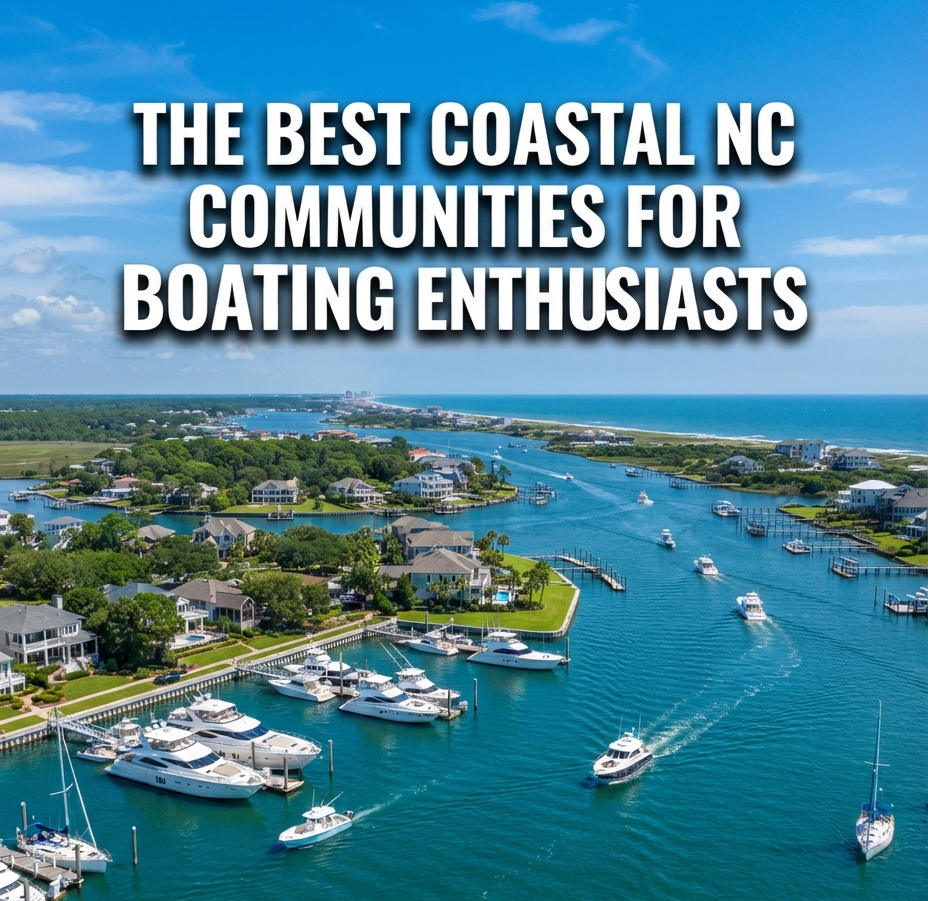
The Best Coastal NC Communities for Boating Enthusiasts

Boating culture runs deep on the North Carolina coast. From the mouth of the Cape Fear River up through Bogue Sound and across to Bald Head Island, generations of families have built lives around getting on the water. For buyers whose real question is not "which home" but "which dock," the community matters as much as the property. Some coastal NC towns are boating-first by design. Others are boating-adjacent. A few are technically on the water but do not deliver the day-to-day boating lifestyle their marketing suggests.

Here is an honest look at the coastal NC communities that actually deliver on the boating lifestyle, drawing on years of matching buyers to the water access they came for.

Hampstead

Hampstead is one of the most consistent boating destinations in this region. The Intracoastal Waterway runs the length of the community, creek systems branch off to give sheltered dock access, and Topsail Inlet is a short run north for open-water access. Waterfront inventory ranges from modest bulkheaded lots on tidal creeks up through luxury ICW-front homes with covered slips, boat lifts, and deepwater dockage.

Hampstead attracts serious boaters who want daily water access without paying oceanfront prices. Local marinas offer wet slips, dry storage, and service. The community around boating is real — fishing tournaments, yacht clubs, and informal networks all support the culture. For buyers whose ideal weekend starts with untying a dock line, Hampstead consistently outperforms alternatives.

Wrightsville Beach and Wilmington Waterfront

Wrightsville Beach and the Wilmington waterfront corridor deliver a different kind of boating. Banks Channel, Motts Channel, and Masonboro Inlet offer sheltered ICW cruising, easy access to open ocean, and world-class fishing grounds within a short run. The lifestyle here is fuller — restaurants accessible by boat, sunset cruises, and a heavy overlap with the Wrightsville social scene.

The trade-off is cost. Waterfront inventory in Wrightsville Beach commands premium pricing, and dock space at the town's marinas fills quickly. Buyers who want the full Wrightsville boating experience should plan for it as part of the purchase math, not an add-on.

Southport

Southport sits at the mouth of the Cape Fear River, where the river meets the Atlantic. That geography makes it one of the best boating locations on the entire NC coast. Deepwater access, the ICW, offshore fishing grounds, and easy runs to Bald Head Island, Oak Island, and Wrightsville are all right there. The town marina, private marinas, and yacht clubs support a large and active boating community.

Retirees who chose Southport specifically for the boating lifestyle are among the most consistently happy buyers I have worked with. The daily rhythm of a small waterfront town, a boat at the dock, and open water minutes away is exactly what many buyers imagine but rarely find.

Sneads Ferry

Sneads Ferry is a working waterfront town with deep boating roots. The New River meets the ICW here, and the community's identity has been tied to commercial and recreational fishing for generations. Waterfront inventory is often more affordable than Hampstead or Southport for comparable water access, though the amenity and dining scene is smaller.

Buyers who value functional water access over resort amenities routinely land in Sneads Ferry. The fishing culture is genuine, the marinas are working marinas, and the community remains authentically coastal.

Sunset Beach and the Brunswick Beaches

Sunset Beach, Ocean Isle Beach, and Holden Beach each offer canal-front and creek-front boating access that is often meaningfully cheaper than the Wilmington-side alternatives. Sunset Beach in particular runs a strong canal-front waterfront market with sheltered water and easy access to the ICW. The community feels quieter than Wrightsville or Southport, which is either the point or the problem depending on the buyer.

The trade-off is that the Brunswick beaches sit further from a major-city boating scene, and dining and services are seasonal. For buyers who want boating as a lifestyle rather than a social scene, this can be exactly the right fit.

Bald Head Island

Bald Head Island sits at the confluence of the Cape Fear and the Atlantic, giving it some of the most versatile boating access anywhere on the NC coast. The island's marina supports full-service boating, and the geography opens onto both river and ocean without navigating congested channels. The trade-off is the island's overall carrying cost and the ferry-access lifestyle. Boaters who love Bald Head love it deeply. Those who chafe at the isolation should look elsewhere.

Topsail Island and Surf City

Topsail Island and Surf City deliver soundside boating on the ICW with easy inlet access to open water. Topsail Beach in particular offers small-town coastal boating culture with dock-friendly properties. Vacation-rental performance is strong for waterfront homes here, which appeals to buyers thinking about eventual rental cash flow to offset carrying cost.

The Best Coastal NC Communities for Boating Enthusiasts

What Boating Buyers Should Actually Evaluate

Dock Type and Water Depth

A dock that dries out at low tide is a very different dock than one that supports a 30-foot boat year-round. Verify tidal range, depth at low tide, and whether the dock accommodates the buyer's actual boat or the boat they intend to buy.

Marina Access

Not every waterfront home needs a private dock. Some boaters prefer marina slips for the service infrastructure. Compare the cost of buying dockage into the home price versus renting marina space.

Inlet and Open Water Access

How far to the nearest inlet? What is the run to the offshore fishing grounds the buyer actually cares about? These practical questions separate boating homes that get used from boating homes that end up as decoration.

HOA and Dock Rules

Some communities allow docks; others do not. Some restrict slip size, boat length, or wet storage. Verify before contract.

Storm Preparation

Coastal boat ownership includes a storm plan. Where does the boat go when a hurricane approaches? The right answer varies by community, and buyers should have one before the purchase, not after.

Key Takeaways

The best coastal North Carolina communities for boating enthusiasts each deliver a different flavor of the lifestyle. Hampstead offers day-to-day ICW access at reasonable prices for serious boaters. Wrightsville Beach and Wilmington deliver a full waterfront social scene at premium cost. Southport sits at a geographically enviable spot where the Cape Fear meets the Atlantic, making it a favorite for retirees who came specifically for the boating. Sneads Ferry offers working-waterfront authenticity at more accessible prices. Sunset Beach and the Brunswick beaches deliver canal-front value with quieter community feel. Bald Head Island rewards boaters who want isolation and versatile water. Topsail and Surf City serve buyers who want soundside coastal culture with vacation-rental economics. The right choice depends less on the marketing and more on the daily reality of dock use, inlet access, storm planning, and community fit. Buyers who match the community to the boating life they actually want to live consistently end up with the right dock and the right neighborhood — and the boat itself finally becomes the everyday possession it was supposed to be all along.

Posted in Carolina Lifestyle
July 22, 2026

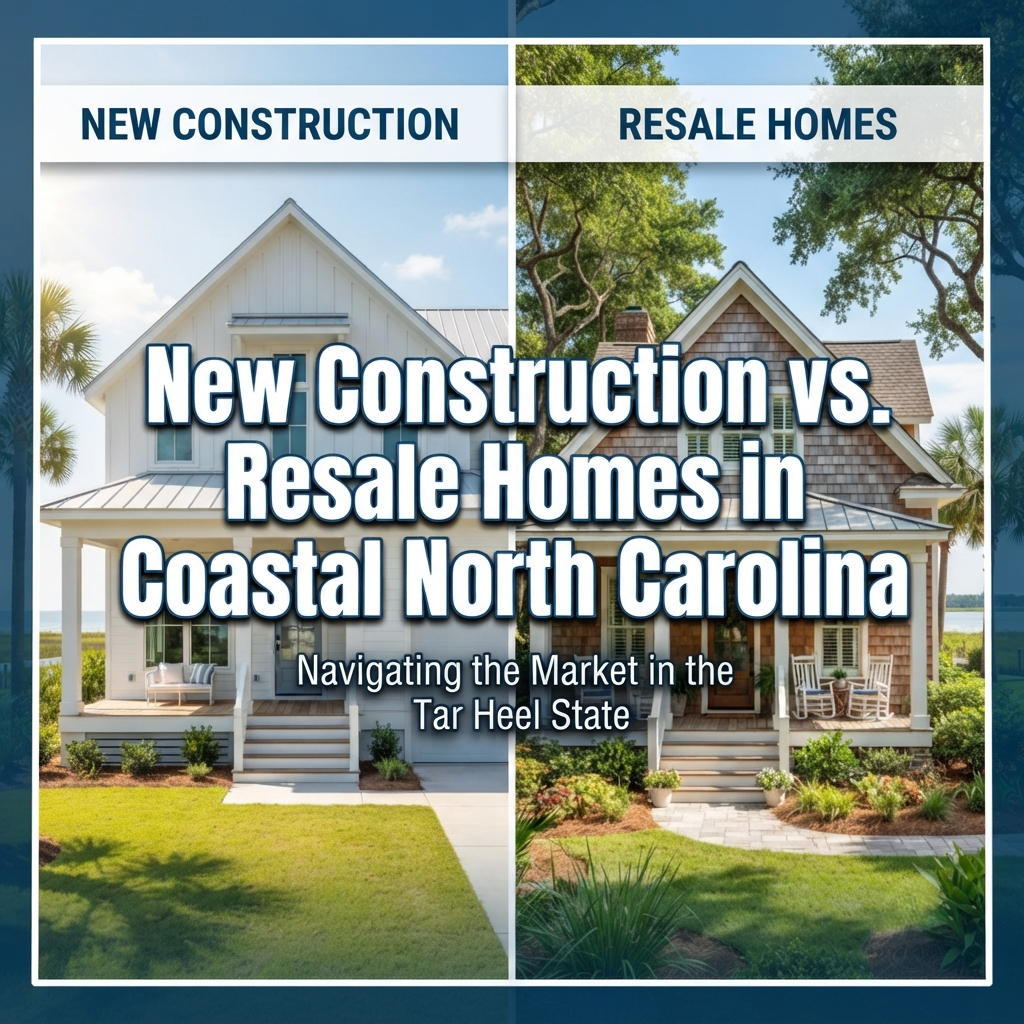
New Construction vs. Resale Homes in Coastal North Carolina

Coastal North Carolina has a live and active new construction market alongside a deep resale market, and buyers routinely try to decide between the two. The right answer is not universal. Each has real advantages, real trade-offs, and real hidden costs. What works for one buyer is exactly wrong for another. After years of walking both product types across Leland, Wilmington, and the Brunswick beaches, here is the honest picture of when new construction wins, when resale wins, and how to tell which fits the specific buyer sitting across the table.

The Advantages of New Construction

Current Building Standards

New construction on the coast is built to current building codes, which include hurricane-hardening requirements that older homes rarely meet. Impact-rated windows, roof-to-wall connections, tie-down straps, and current electrical and plumbing standards are all baseline features. Insurance carriers typically quote better rates on new construction, and buyers see the benefit in monthly carrying cost.

Warranty Coverage

New construction almost always comes with a builder warranty — typically one year on general workmanship, two years on systems, and ten years on structural. That coverage removes a category of surprise expenses that resale buyers routinely face.

Finish Selections and Layout

Buyers who purchase during construction can choose finishes, upgrades, and sometimes floor plan changes. The home matches the buyer's preferences rather than the previous owner's.

Lower Immediate Maintenance

New roof, new HVAC, new appliances, new hot water heater. The maintenance calendar starts fresh, and the first several years typically bring only routine upkeep.

Energy Efficiency

New homes are meaningfully more energy efficient than most resale inventory. Better insulation, higher-efficiency HVAC, and modern windows lower monthly utility bills. On the coast, where humidity and cooling loads are significant, this matters.

The Advantages of Resale

Established Neighborhoods

Resale homes typically sit in neighborhoods that have finished growing. Mature trees, established landscaping, understood traffic patterns, and settled community culture. New construction communities are often still being built out, with construction activity and changing demographics.

Location Access

Many of the best locations in the region — walkable downtown Wilmington, oceanfront Wrightsville Beach, the historic Southport district, established sections of Landfall — are essentially resale-only because there is no land left to develop. Buyers who want those specific locations have to buy resale.

Real Comparable Sales

Resale homes trade against clear comparable sales. Buyers and appraisers can defend the price with recent nearby transactions. New construction pricing is often less transparent, and the builder's asking price does not always match what the home will appraise for at resale.

Lower Price Per Square Foot

In most coastal NC submarkets, resale homes trade at meaningfully lower cost per square foot than comparable new construction, even accounting for age-related maintenance needs. Buyers who value dollar-for-dollar space often lean resale.

Faster Move-In

Resale can close in 30 to 45 days from contract. New construction can take 6 to 14 months from contract to move-in, depending on stage of construction. Buyers with a relocation timeline often have no choice but resale.

New Construction vs. Resale Homes in Coastal North Carolina

Where New Construction Struggles

Builder-driven timelines are the biggest source of new construction frustration. Delays are common, particularly in coastal markets subject to weather and supply chain variability. Punch lists at closing can be long, and warranty response times vary widely by builder. Buyers should research the builder's reputation as carefully as they research the community.

Capital contribution fees at closing in some master-planned communities can add several thousand dollars beyond the base price. HOA dues in new construction communities sometimes rise sharply after builder transition to homeowner control. Both should be part of the buyer's math.

Where Resale Struggles

Deferred maintenance is the biggest resale risk. Older coastal homes often have aging roofs, older HVAC systems, dated finishes, and hidden issues that surface during inspection. Insurance carriers scrutinize resale homes more carefully, and rates can be higher than new construction on comparable inventory. Buyers should build a real repair-and-replacement reserve into their purchase math.

Resale sellers can be less flexible than builders. A builder with a soft month has room to negotiate; an individual seller emotionally attached to their home often does not. The negotiation dynamic is different.

Which Coastal NC Markets Have Meaningful New Construction

Leland

The largest new construction pipeline in the region. Brunswick Forest, Compass Pointe, Waterford of the Carolinas, and multiple standalone communities all deliver significant new inventory each year.

Wilmington

Newer construction in areas like Riverlights, Scotts Hill, and select Porters Neck sections. Less volume than Brunswick County but ongoing activity.

Hampstead

Steady Hampstead new construction across the corridor, with waterfront and near-waterfront pockets driving the higher end.

Burgaw and Rural Pender

Smaller-scale but growing new construction, often on larger lots and appealing to buyers who want space.

Beach Towns

Limited by land availability. New construction on the actual barrier islands is mostly teardown-and-rebuild rather than greenfield development.

What to Ask a Builder

How long has the builder operated in this region and how many homes have they delivered? What is the warranty structure and how does the builder handle warranty claims? Are there capital contribution fees, and what do current HOA dues look like? What is the projected HOA cost after homeowner transition? What are the current build times, and what happens if closing is delayed? Which finishes are standard versus upgrade, and what is the cost of the upgrades most buyers want? These questions separate strong builders from marginal ones.

What to Ask a Resale Seller

How old is the roof, HVAC, water heater, and major appliances? Are there any known issues the seller has been meaning to address? Has the property flooded, and if so, has it been remediated and reported? Is there an elevation certificate and current insurance policy the buyer can review? What is the most recent CLUE report? These questions surface the resale story efficiently.

Total Cost of Ownership

New construction generally has lower initial repair and replacement costs but higher purchase price and sometimes higher HOA. Resale generally has lower purchase price but higher near-term maintenance and reserve requirements. Over a 10-year hold, the totals often converge more than the initial price gap suggests. Buyers should model both paths honestly rather than assuming one is uniformly cheaper.

Key Takeaways

  • New construction offers current codes, warranty coverage, choice of finishes, and lower near-term maintenance — often with higher purchase price and sometimes longer timelines
  • Resale offers established neighborhoods, better-located inventory, lower price per square foot, and faster closing — with more variable maintenance surprises
  • The best locations in the region are often resale-only because there is no land left to develop
  • Insurance carriers typically price new construction more favorably; resale roofs and older systems draw closer scrutiny
  • Builder reputation matters as much as community selection — research delivery history and warranty responsiveness before contract
  • Capital contribution fees, HOA transition math, and build delays are the biggest new construction gotchas
  • Deferred maintenance, aging systems, and flood history are the biggest resale gotchas
  • Over a 10-year hold, total cost of ownership between the two paths often converges more than the sticker price suggests

Frequently Asked Questions

Which is cheaper long-term — new construction or resale?

Depends on the specific home and hold period. New construction often costs more up front but requires less maintenance and reserves early. Resale usually costs less up front but requires more maintenance and reserves. Over a 10-year hold, the totals frequently converge.

Do coastal NC builders honor their warranties?

Most established builders do. Warranty responsiveness varies by builder, and prospective buyers should ask past customers about their post-closing experience. Reputable builders treat the warranty period as a marketing tool for future sales.

Is a spec home the same as a custom home?

No. A spec home is built to the builder's design and finish package without buyer input. A custom home reflects the buyer's specifications. Semi-custom homes allow finish selections and sometimes floor plan changes within builder templates. Each has different cost, timeline, and control implications.

How much do capital contribution fees typically add?

Often one to three months of HOA dues in coastal NC master-planned communities, sometimes more. On a $500 monthly HOA, that could be $500 to $2,500 or higher at closing. Verify with the specific community before contract.

Are new construction homes appraising below contract price?

Sometimes, particularly on premium finish packages or in softening market pockets. Buyers financing new construction should be prepared for potential appraisal gaps and understand the builder's flexibility if one arises.

Posted in For Buyers
July 21, 2026

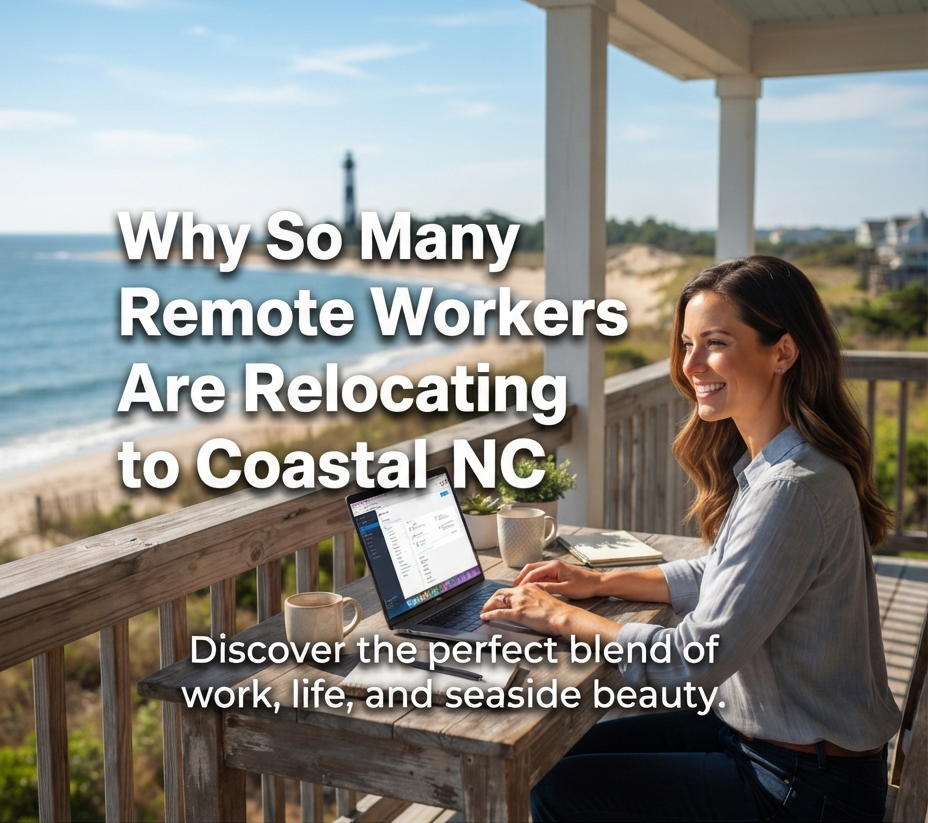
Why So Many Remote Workers Are Relocating to Coastal NC

The remote work migration into coastal North Carolina is one of the quieter but more consequential real estate shifts of the last five years. Between 2020 and 2026, tens of thousands of full-time remote and hybrid professionals traded the Northeast, the Midwest, and coastal Florida for the Wilmington region. The wave has slowed slightly from its 2021 peak but has not reversed. In 2026, remote workers remain one of the three largest buyer pools in this market alongside retirees and military families. Here is why the pattern continues, where remote workers are landing, and what makes coastal NC unusually well suited to the way remote work actually plays out day to day.

The Fundamentals Line Up

Real Internet Infrastructure

Coastal NC is not a rural bandwidth desert. Fiber and gigabit cable service is broadly available in Wilmington, Leland, Hampstead, and the master-planned communities. Even smaller towns like Southport, Shallotte, and Burgaw have workable service. Remote workers who care about upload speeds for video calls and file transfers can find the bandwidth they need in most markets.

Cost of Living That Actually Works

A remote worker earning a Northeast or California salary while living in Brunswick or Pender County lives well below their income. Housing costs less. Property taxes are moderate. Everyday services are meaningfully cheaper than the buyer's origin market. The financial math is a real driver, not just a marketing pitch.

Coastal Lifestyle Without a Long Weekend

For remote workers, the biggest lifestyle upgrade is that the coast is not somewhere they visit — it is where they live. Morning runs on the beach, kayaking at lunch, sunset from the deck. The commute is from the coffee pot to the desk. That everyday accessibility to the coast is the single most cited reason remote workers say they made the move.

Airport and Travel Access

Wilmington International Airport (ILM) connects to major East Coast hubs, and Raleigh-Durham (RDU) is a two-hour drive. Remote workers who travel occasionally for team offsites or client visits can get where they need to go without living near a hub.

Where Remote Workers Are Actually Landing

Wilmington Proper

Downtown Wilmington, Mayfaire, and the Wrightsville-adjacent neighborhoods draw remote workers who want small-city amenities, walkable coffee shops and restaurants, and quick beach access. The historic district in particular has attracted younger professionals who want character over new construction.

Leland and Brunswick County Amenity Communities

Brunswick Forest, Compass Pointe, and Magnolia Greens serve remote workers who want more space, newer construction, and amenity-rich living at lower price points than Wilmington proper. The demographic mix skews slightly older but is trending younger every year.

Hampstead

Hampstead's location between Wilmington and the Topsail beaches — plus its schools, waterfront access, and Pender County tax structure — pulls remote workers who want the community feel without giving up beach access or a manageable commute for the occasional in-office day.

Burgaw

Burgaw serves the remote worker who wants land, quiet, and small-town character. The trade-off is a longer drive to Wilmington-area services, but for the right buyer, the peace is the point.

Beach Towns

Full-time remote workers are increasingly settling in beach towns — Oak Island, Carolina Beach, Sunset Beach, Topsail — that used to be dominated by vacation homes. The beach lifestyle plus year-round residency is a specific choice that a subset of remote workers make and love.

Who These Buyers Are

The remote worker buyer pool is broader than the stereotype. Software developers and engineers are heavily represented, as are marketing professionals, consultants, financial services professionals, creative professionals, healthcare administrators, and academics. Ages range widely — many are in their thirties and forties, though remote-eligible professionals of any age are moving. Many are dual-income households where one or both partners work remotely.

Why So Many Remote Workers Are Relocating to Coastal NC

What Remote Workers Actually Want in a Home

A Real Home Office

A dedicated home office with a door, natural light, and space for a proper desk setup is not optional. Buyers routinely walk homes with a specific room in mind for this. Bonus rooms, dedicated dens, and even converted garages all fit.

Outdoor Living

Remote workers use outdoor space more than any other buyer pool. A screened porch that fits a laptop for morning calls, a deck for lunch breaks, a small yard for a coffee walk — all matter more than they do to a commuting buyer.

Fast, Reliable Internet

Buyers should confirm the specific provider, plan, and typical speeds at the exact address. Marketing claims about "gigabit available" do not always mean the home in question is served at gigabit levels.

Quiet and Layout

Homes on quiet streets and layouts that let a remote worker close a door on video calls consistently outperform open-plan layouts that force meetings to compete with household noise.

The Second-Wave Buyer

An interesting recent trend is the "second-wave" remote worker — the person who moved to a smaller town during 2020 to 2022, discovered they missed some urban infrastructure, and is now relocating a second time to coastal NC because it delivers coast, culture, and cost balance in a way their first move did not. Wilmington in particular is benefiting from this second-wave migration.

Common Mistakes Remote Workers Make

Buying too far from services or infrastructure they will actually use. Overestimating how often they will fly home and picking a home far from the airport. Underestimating hurricane season practical impacts. Choosing a home without a real office space. Skipping the fiber verification. Each is fixable in advance and painful to fix in year two.

Key Takeaways

  • Coastal NC has become one of the top remote-work relocation destinations on the East Coast because internet infrastructure, cost of living, coastal lifestyle, and travel access all line up
  • Wilmington proper draws remote workers who want small-city amenities and walkability; Leland and other Brunswick amenity communities draw those who want more space and lower cost
  • Hampstead balances coast plus city access; Burgaw serves the buyer who wants space and quiet; beach towns work for full-time coastal living
  • The remote worker buyer pool is broad — software, marketing, finance, creative, healthcare, academia — and dual-income households are common
  • A dedicated home office, real outdoor living space, fast verified internet, and a quiet layout matter more to remote workers than to other buyer pools
  • Second-wave remote workers — those making a second post-pandemic move — are an increasingly common buyer profile in Wilmington
  • Common mistakes are geographic — buying too far from services, the airport, or the infrastructure the worker will actually use

Frequently Asked Questions

How fast is home internet in coastal NC?

Gigabit fiber is available in most established Wilmington-area, Leland, and Hampstead neighborhoods, and in select master-planned communities across the region. Rural and beach town coverage is variable — buyers should confirm speeds at the specific address.

Is there a co-working scene in Wilmington?

Yes. Several co-working locations operate in Wilmington and Leland, and many coffee shops cater to remote workers. Meetup groups for remote professionals also run in the region for those who want in-person community.

Do remote workers usually keep or sell homes in their previous city?

Both patterns are common. Buyers who plan to visit their previous city often rent it out; buyers who are cleanly relocating usually sell. Tax implications differ, and a CPA conversation before selling is often useful.

How does hurricane season affect remote work in coastal NC?

Most storms pass without a work impact. Serious storms can cause power outages and internet disruptions for one to several days. Remote workers should plan for a backup workspace and consider a small generator or UPS for critical equipment.

Is there a remote-worker community in coastal NC?

An informal one, yes, and growing. Many neighborhoods now have multiple remote-worker households, and community groups increasingly include remote workers as core members. The social infrastructure is real without being labeled.

Posted in For Buyers
July 20, 2026

Understanding Septic Systems in Coastal North Carolina

Buyers relocating to coastal North Carolina from municipal-sewer markets are often surprised to learn how many of the homes they tour run on septic instead. In much of Pender County, unincorporated Brunswick County, and the outer neighborhoods of New Hanover County, septic is the default rather than the exception. Septic is not a problem — millions of homes in this country operate on well-designed and properly maintained septic systems for decades — but it does behave differently than city sewer, and buyers should understand the difference before they contract.

Here is what every coastal NC buyer needs to know about septic, from the inspection through the long-term operating cost, drawing on years of walking properties across Hampstead, Burgaw, and the outer Wilmington-area communities.

What a Septic System Actually Does

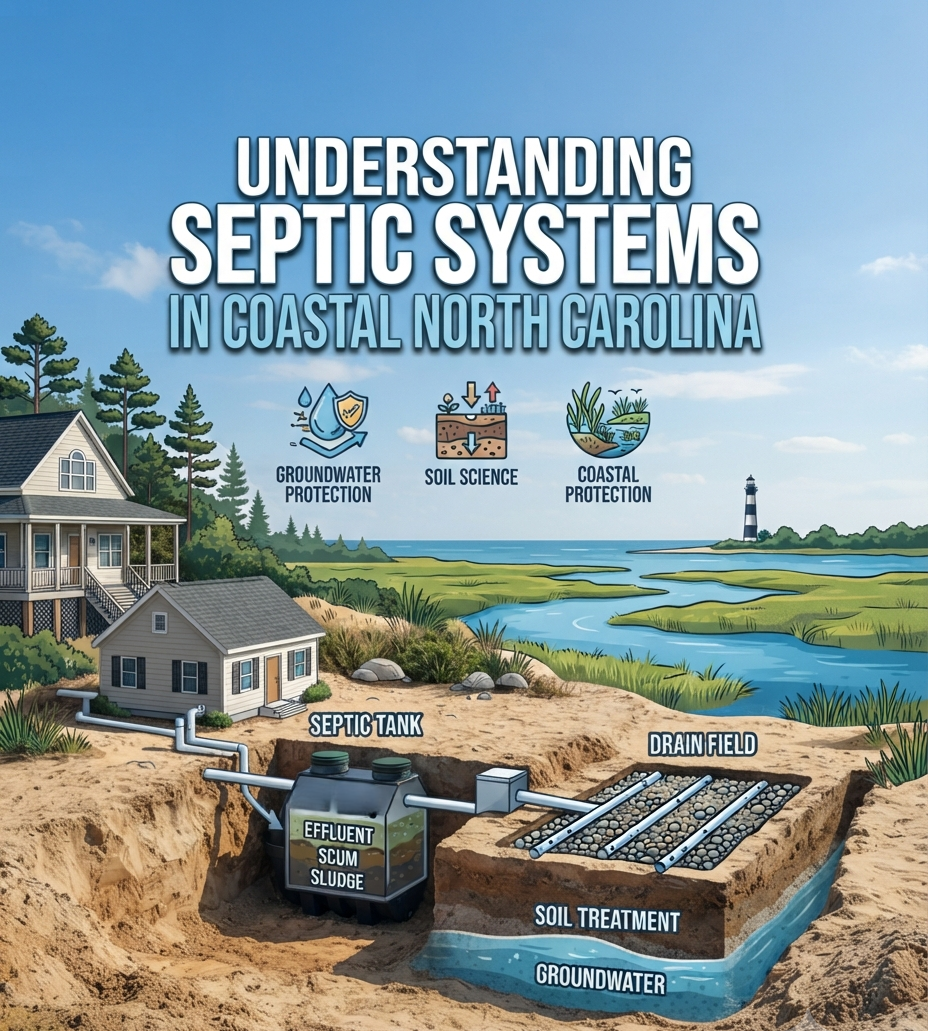
A septic system is an on-site wastewater treatment plant. Waste from the house flows to a septic tank, where solids settle and are partially broken down by bacteria. The liquid effluent then flows to a drain field, where soil and gravel filter the water further before it returns to the water table. The system depends on healthy bacteria, adequate soil percolation, and a drain field that has not been compacted, damaged, or overwhelmed.

When those conditions are met, a septic system runs quietly in the background for decades. When they are not, the failure modes are ugly — backups, drain field saturation, groundwater contamination, and expensive repairs.

Types of Systems in Coastal NC

Conventional gravity systems are the most common. Wastewater flows by gravity to the tank and then to a gravel-and-soil drain field. Pump systems are used when the drain field sits uphill or at a distance from the tank; the tank includes a pump chamber that pushes effluent to the drain field.

Advanced treatment systems — often called "innovative" or "engineered" systems — are used when soil conditions do not support a conventional drain field. These include aerobic treatment units, mound systems, drip irrigation, and low-pressure pipe systems. Advanced systems cost more up front, require regular professional service contracts, and have shorter maintenance intervals. Coastal properties near marshes or in areas with poor soil often use these systems, and buyers should verify the system type and its ongoing service requirements.

The Inspection and Permit Story

Every septic system in North Carolina was installed under a permit issued by the county health department. The permit specifies the number of bedrooms the system was designed to support, the tank size, the drain field size, and often the location. Buyers should always request a copy of the septic permit during due diligence — the county keeps it on file, and the seller usually has one too.

A septic inspection is different from a home inspection. Home inspectors do not open septic tanks or evaluate drain fields. Buyers should hire a licensed septic contractor to pump the tank, inspect the baffles, evaluate the drain field, and check the pump if applicable. The cost is modest — usually $300 to $800 — and the report is essential.

Bedroom Count Matters

Septic systems are permitted for a specific number of bedrooms. A three-bedroom-permit system installed in a home that has since been expanded to five bedrooms is a real problem — the system is undersized for the actual use, and the discrepancy can affect future permits, additions, and even resale. Buyers should compare the septic permit's bedroom count to the home's current configuration.

Drain Field Location and Setbacks

Drain fields need protection. Vehicles cannot drive over them. Trees cannot be planted on them. Structures cannot be built over them. Buyers should ask for the drain field location and understand the setbacks required by the county. On smaller lots, drain field placement can meaningfully limit future landscaping, expansion, and outdoor structures.

Wells Often Come With Septic

Homes on septic frequently also run on private wells rather than city water. Well water quality is not automatic. Buyers should have the well tested for bacteria, nitrates, and metals during diligence. The test is inexpensive, and the result is important. Some coastal NC wells also require ongoing water treatment — softeners, filters, or UV systems — to deliver acceptable water quality.

Maintenance Rhythm

A typical coastal NC septic system needs the tank pumped every three to five years, depending on household size. Advanced treatment systems need professional service every six months to a year. Owners should not flush non-degradable items, grease, harsh chemicals, or excessive antibacterial products. The rule of thumb is simple — if it did not come out of the human body or is not thin toilet paper, it should not go into the septic system.

The annual operating cost of a well-run septic system is small — typically $150 to $600 depending on type and service requirements. Failing to maintain the system leads to costs that are orders of magnitude larger.

Understanding Septic Systems in Coastal North Carolina

When Septic Fails

Failures usually announce themselves through slow drains, gurgling pipes, foul odors, or wet spots in the yard around the drain field. A failing drain field is the most expensive fix — often $8,000 to $25,000 for a full replacement, more for advanced systems. Buyers should treat any active symptoms in a home they are touring as a real diligence item.

Insurance and Financing Considerations

Standard homeowners policies typically do not cover septic system failure unless the failure is caused by a covered peril. Buyers should ask about septic-specific coverage or riders if the system is older. Lenders occasionally require septic inspection reports as part of loan closing, especially for VA and USDA loans; the borrower should ask early.

Long-Term Ownership

Most coastal NC septic systems installed in the last 30 years work fine when maintained. The failure mode is usually neglect, not manufacturing defect. Buyers who plan to hold for the long term should assume that the drain field will eventually need work — most systems require some drain field intervention over a 30-year hold — and budget accordingly.

Key Takeaways

Septic is not a red flag in coastal North Carolina — it is simply a different way of handling household wastewater than most buyers are used to from municipal-sewer markets. A well-installed, properly permitted, and adequately maintained system runs quietly for decades and costs very little to operate. The keys are verifying the permit's bedroom count matches the home, hiring a licensed septic contractor to inspect the tank and drain field during diligence, protecting the drain field from vehicles and trees, keeping to the pumping and service schedule, and following the simple rules about what goes into the system. Buyers should also test the well if the property has one, understand the setbacks that affect landscaping, and budget for the eventual drain field intervention that comes with any long hold. Buyers who go in informed treat septic as background infrastructure and get on with living in the home. Buyers who go in uninformed are the ones surprised by a system that quietly failed while they were assuming it worked like city sewer.

Frequently Asked Questions

How much does it cost to replace a coastal NC septic system?

Conventional gravity systems typically run $6,000 to $15,000 for a full replacement, depending on tank size, drain field size, and soil conditions. Advanced treatment systems can run $18,000 to $35,000 or more. Buyers should always get a specific quote from a licensed installer rather than relying on rules of thumb.

Can I add a bedroom to a home on septic?

Sometimes. The septic system must be permitted for the increased bedroom count. If it is not, the county will require a system upgrade before approving the addition. Buyers planning future expansion should confirm the system's permit capacity before contract.

Are there parts of coastal NC where septic is not allowed?

Incorporated municipal areas typically require connection to city sewer where sewer lines are available. In rural and unincorporated areas, septic is often the only option. The county health department can confirm what applies to a specific address.

What is the difference between a septic inspection and a septic pump-out?

A pump-out empties the tank. An inspection opens the tank, checks the baffles, evaluates the effluent level, and assesses the drain field's function. Most licensed contractors will do both in the same visit, which is what buyers should request.

Does a septic system affect home resale?

Only if the system has issues. A well-maintained septic system with a clean inspection report is functionally invisible in a coastal NC transaction. A neglected or failing system will affect the deal significantly.

Posted in For Buyers
July 17, 2026

How to Choose the Right Coastal Community for Your Lifestyle

Coastal North Carolina is not one market. It is a dozen distinct communities within an hour's drive of each other, each with its own personality, price point, and daily lifestyle. Buyers who spend a weekend touring five towns often come back more confused than when they started, because the towns feel similar on paper and radically different in person. The right coastal community is the one that fits how the buyer actually wants to spend a day — not the one that photographs best or ranks highest on a magazine list.

Here is a practical framework for matching yourself to the right coastal NC community, drawing on years of watching buyers make this decision well and, occasionally, badly.

Start With the Daily Rhythm You Want

The single most useful question a buyer can answer is what an ordinary Tuesday looks like in their new coastal life. Coffee on a walkable downtown block, then a walk to the water? A morning bike ride in a master-planned community, then tennis with neighbors? A short drive to the beach, then errands in a shopping corridor? A boat trip out of a private dock behind the house? Each of those points to a very different community.

Buyers who cannot describe their ideal Tuesday usually cannot pick the right community, because they are shopping features instead of lifestyle.

The Wilmington-Proper Buyer

Wilmington proper suits buyers who want a real city experience with coastal access. Historic downtown, midtown, Mayfaire, and the Ogden and Porters Neck areas each deliver a different feel, but all share the city's cultural infrastructure — restaurants, theaters, medical, UNCW, the airport, and a walkable historic district. Wilmington is the answer for buyers who want to be near the coast without giving up the amenities of a small city.

Trade-offs: municipal taxes are higher than in unincorporated Brunswick County, traffic on the main corridors during peak hours is real, and pricing in the desirable in-town neighborhoods reflects the demand.

The Brunswick County Buyer

Leland and the Amenity-Community Buyer

Leland suits buyers who want master-planned community life, easy Wilmington access, and Brunswick County tax rates. Brunswick Forest, Compass Pointe, Magnolia Greens, and Waterford of the Carolinas each attract slightly different demographics but all deliver amenity-rich living at meaningfully lower prices than comparable inventory in Wilmington proper.

Southport and the Small-Town Walker

Southport suits buyers who want a genuine small town — walkable historic district, waterfront, small businesses, and a strong sense of community. Retirees and second-home buyers dominate the profile. Boaters love the deepwater access.

Oak Island, Holden Beach, Sunset Beach

The Brunswick beaches suit buyers who want to actually live on the beach or nearby. Vacation-rental investors and second-home buyers make up much of the market. Full-time residents find real community, but daily infrastructure (medical, retail, dining) is smaller-scale than mainland options.

 How to Choose the Right Coastal Community for Your Lifestyle

The Pender County Buyer

Hampstead

Hampstead suits buyers who want the coast plus city access. Fifteen minutes to the beach, thirty to Wilmington, ICW waterfront access, and Pender County Schools that draw a strong family demographic. Boating buyers, families, and remote workers all land here consistently.

Burgaw

Burgaw suits buyers who want land, small-town feel, and reasonable Wilmington access. Slower pace, more space, lower price point. Not for buyers who want walkable amenities within their neighborhood.

The Topsail and Surf City Buyer

The Topsail Island corridor and Surf City suit buyers who want quintessential barrier-island beach life — soundside kayaking, oceanfront sunsets, and a family-vacation feel that stays right through retirement. Vacation-rental performance is strong, and long-term appreciation on waterfront inventory has held up well.

The Waterfront-Focused Buyer

Any of the above communities can deliver waterfront living, but each does it differently. Wrightsville Beach and Bald Head Island deliver premium oceanfront and ICW-front living. Southport and Hampstead deliver deepwater dock access on the ICW and creek systems. The Brunswick beaches deliver canal-front living and boat access. Sneads Ferry delivers working-waterfront proximity. Waterfront buyers should match dock type, water depth, and boating destination to the specific home.

Practical Questions to Ask During the Search

Commute and Job Access

If any household member commutes, drive the commute at rush hour before committing. Coastal NC traffic has grown, and what looks like a 20-minute drive on Google Maps can be 40 minutes at 5 p.m.

Medical Infrastructure

How far is the nearest primary care, specialty care, and hospital? For retirees and buyers planning long holds, this matters more than they think it will.

School Assignment

Each town's schools serve a different district — New Hanover, Brunswick, Pender, Onslow. Verify the specific assignment on the specific address, not the town's general reputation.

Community Culture

Visit the local coffee shop or grocery. Attend a farmers' market or a community event. The way people interact in daily life tells you more about fit than any listing description.

HOA and Rules

Amenity communities have rules. Buyers who dislike HOAs should shop communities without one. Buyers who want structure should shop amenity communities.

Common Mismatches

The Wilmington-luxury buyer who bought oceanfront on Oak Island because it looked beautiful and now misses the Wilmington restaurant scene. The remote worker who bought in Burgaw for the land and did not realize how far it is from the airport. The retiree who wanted a walkable town and bought in a car-only master-planned community. Each of these is fixable, but each is expensive to fix at resale. Better to match community to lifestyle at the beginning.

The Test Weekend

Before committing to a community, spend a weekend there living the intended lifestyle. Rent a place or visit for a scouting trip. Walk the neighborhood. Go to the local coffee shop, the grocery store, the farmers' market. Drive the commute at rush hour. Eat at the restaurants the community actually uses. Two days of real presence beats ten hours of touring homes with an agent.

Key Takeaways

  • The right coastal NC community fits the buyer's ideal ordinary Tuesday, not the community's best photo
  • Wilmington proper suits buyers who want small-city amenities plus coastal access, at a higher price and tax point
  • Leland and other Brunswick County amenity communities suit buyers who want master-planned living and lower tax rates with easy Wilmington access
  • Southport, Hampstead, and Burgaw each fit a distinct lifestyle — small-town walking, coast-plus-city, or land and quiet respectively
  • Brunswick beaches, Topsail, and Surf City serve buyers who want to live on the beach or nearby, with trade-offs in infrastructure
  • Practical diligence — rush-hour commute, medical access, school assignment, community culture, HOA rules — separates the right choice from the wrong one
  • A test weekend living the intended lifestyle in the community beats any amount of daytime home touring

Frequently Asked Questions

How long should I plan for my coastal community search?

Serious searches usually run three to six months from initial visits to closing. Buyers who compress the timeline often miss the fit; buyers who stretch it beyond six months sometimes lose momentum. The right pace depends on how well the buyer already knows the region.

Should I rent before I buy in coastal NC?

For buyers relocating from far away, yes when possible. Even a 30 to 90 day rental lets a buyer test the actual daily lifestyle. Buyers already familiar with the region can typically skip the rental step.

What is the biggest mistake buyers make choosing a community?

Buying the home instead of the community. A beautiful home in the wrong community produces years of quiet frustration. A modest home in the right community produces years of happiness. Community fit outranks home features.

How do I compare tax and insurance costs across communities?

Run the actual annual carrying cost on a specific home in each candidate community — property tax including any municipal overlay, wind and hail, homeowners, flood, and HOA. The relative math is often quite different from the general reputation of the town.

Is it better to buy new construction or resale in an amenity community?

Both work. New construction gives current finishes and warranty coverage but often costs more per square foot and can face HOA capital contribution charges. Resale gives established landscaping, understood HOA behavior, and often lower entry price. Match to preferences and budget.

Posted in For Buyers
July 16, 2026

How Salt Air Impacts Coastal Homes and Maintenance Costs

Salt air is the quiet operating cost every coastal homeowner eventually understands. It does not announce itself. It does not appear in a home inspection report as a single line item. It just steadily accelerates the aging of every material on the house, and the bill for that acceleration shows up over years and decades rather than in a single event. Buyers who understand what salt actually does to homes plan for it in their maintenance budget. Buyers who do not are surprised in year three when the HVAC condenser fails and the paint on the south side of the house has already flaked.

Here is the honest picture of what salt air does to coastal North Carolina homes, drawing on years of walking properties from Wrightsville Beach and Carolina Beach down through Oak Island and the Brunswick beaches.

How Salt Actually Attacks a House

Salt aerosols are carried inland by wind. They deposit on every exterior surface — roof, siding, decks, windows, HVAC condensers, exterior lights, hardware, and door thresholds. When those surfaces are also exposed to sun and moisture, the salt accelerates oxidation, corrosion, and material breakdown. Metal corrodes faster. Paint fails sooner. Rubber and plastic degrade more quickly. Wood decays sooner in humid, salt-laden conditions.

The intensity of exposure drops with distance from open water. An oceanfront home experiences a fundamentally different maintenance cycle than a home a mile inland. Homes on Oak Island, Wrightsville Beach, and Bald Head Island are the most exposed. Homes in inland Leland, Hampstead, or western Wilmington see much lower salt loads. Both still qualify as coastal, but their maintenance profiles are meaningfully different.

What Wears Out Fastest

HVAC Condensers

The single most-common salt-driven failure is the outdoor HVAC condenser. Salt corrodes the aluminum fins, seizes the fan motor bearings, and eats away at the copper coil connections. Coastal condensers typically last 10 to 12 years instead of the 15 to 20 that inland units achieve. Coastal-rated condensers with protective coatings can extend the life meaningfully, but they cost more up front.

Roofs and Flashing

Salt accelerates the wear on shingle asphalt, causing granule loss and shortening functional roof life. Roof flashing, drip edges, chimney caps, and roof vents corrode. Coastal roofs typically need replacement at 15 to 20 years instead of the 25 to 30 that inland roofs commonly achieve.

Exterior Paint and Stain

Paint on the sunny, wind-exposed sides of the house — usually the south and east on this coast — fails faster than on protected sides. Coastal homes typically need repainting every 5 to 8 years instead of the 10 to 12 that inland houses often achieve. Deck stain follows the same pattern.

Windows, Doors, and Hardware

Salt corrodes hinges, door locks, window screens, exterior lights, and hardware. Vinyl and aluminum window frames hold up better than wood and steel. Stainless steel and coastal-rated hardware are worth the premium.

Outdoor Furniture and Grills

Furniture, grills, umbrellas, cushions, and outdoor cooking equipment age quickly in salt environments. Investing in quality coastal-rated pieces from the start typically outperforms cheaper replacements over a five-year window.

Vehicles and Bicycles

Not the house directly, but worth mentioning — cars, bicycles, and outdoor toys corrode faster in salt environments. Rinse-off routines make a real difference.

How Salt Air Impacts Coastal Homes and Maintenance Costs

Regional Variation Within Coastal NC

Not all coastal NC homes face the same salt load. Direct oceanfront and immediately near-oceanfront properties experience the highest exposure. Sound side, marsh-front, and ICW-adjacent homes face moderate exposure — usually less than oceanfront but more than inland. Homes a mile or more inland from open water see meaningfully lower exposure. Homes 10 to 15 miles inland behave much like inland markets.

This variation matters when buyers compare carrying costs across properties. Two homes that look similar on paper can have quite different maintenance profiles based on wind direction and distance from the water.

How to Slow the Damage

Rinse Routinely

The simplest and most effective salt-mitigation strategy is regular fresh-water rinsing. HVAC condensers benefit from a monthly rinse. Outdoor light fixtures, door hardware, and exterior surfaces benefit from a quarterly rinse or pressure wash. This routine is not glamorous, but it extends equipment life meaningfully.

Use Coastal-Rated Materials

When it is time to replace anything on the exterior — condenser, hardware, lights, deck screws, roof flashing — spend the extra for coastal-rated or marine-grade materials. The initial cost premium typically pays back within a few replacement cycles.

Invest in the South and East Sides

The south- and east-facing sides of the house take the most sun and wind exposure. Higher-quality paint, thicker sealants, and more frequent maintenance on those sides return more than the same investment on the protected sides.

Do Not Delay Maintenance

Deferred maintenance compounds on the coast. A roof issue that could be a $500 flashing repair in year one becomes a $6,000 water-damage repair by year three. Coastal homes penalize procrastination.

Budgeting the Real Costs

A reasonable annual maintenance budget for a coastal NC home runs 1 to 3 percent of the home's value, with the higher end applying to oceanfront and near-oceanfront properties. On a $1,000,000 home, that means $10,000 to $30,000 annually as a rolling average. Some years are lower — a quiet year with just routine maintenance. Some years are much higher — a roof replacement or HVAC replacement year. The average matters more than any single year.

Owners who set up a dedicated coastal reserves account and contribute monthly generally handle these costs without stress. Owners who wait for the bill to arrive often scramble.

What Buyers Should Ask Before They Contract

Age of the roof, age of the HVAC systems, most recent exterior paint or stain year, condition of decks and porches, and the seller's routine maintenance history. All of these should be part of the diligence conversation. Homes that have been maintained proactively are worth measurably more than homes that have been let go, even when the two look similar in photos.

Key Takeaways

Salt air is a real and steady operating cost of coastal North Carolina ownership. It accelerates the aging of every exterior material on the home — HVAC condensers, roofs, paint, hardware, windows, doors, and decks — and it does so quietly enough that buyers who did not plan for it are often surprised by year three or four. The right response is not to avoid the coast; it is to buy the home with realistic maintenance expectations, budget 1 to 3 percent of value annually for upkeep, invest in coastal-rated materials during any replacement cycle, rinse and pressure-wash routinely, and address issues before they compound. Homes that have been maintained proactively are worth measurably more at resale than homes that have not. Buyers who go in understanding the salt-air math consistently love their coastal home. Buyers who assume coastal maintenance costs match inland maintenance often become the sellers who wonder why their home is not showing well after five years. Coastal ownership rewards attention to the exterior. Everything else follows from that.

Posted in For Buyers